
Somewhere around the fifth therapist profile, they all start to blur. Warm. Evidence-based. Accepting new clients, maybe. You opened one tab because your chest wouldn't unclench, and now you have twelve.
It's hard enough deciding to try therapy… then you realize you have to find the right person for you. An incredibly vulnerable journey to sit in a chair and talk to a stranger, all based on your own guesswork. We are not surprised that the most common response to "go to therapy" is "how do I even find the right therapist?" This is where we come in. saymore created The Match, an online tool where we do the heavy lifting for you. One intake about what you're carrying, how you communicate, and what you can spend, and we match you with a California therapist who also answered questions about themselves, how they work, and how they can help. It's free for you, always. And if therapy feels like too big a first step, you don't have to start there.
It rarely announces itself
Anxiety almost never introduces itself by name. It looks like the 2 a.m. replay of a conversation from three days ago. The email you've rewritten five times and still haven't sent. Plans you canceled even though you wanted to go, because the getting-there felt impossible. A body sounding every alarm while, on paper, nothing is wrong. (The on-paper part never helps.)
Our founder describes it this way:
Anxiety for me feels like paranoia after a social gathering with my close friends that I trust… do they hate me? Did I upset someone? Was that a weird moment? Anxiety goes beyond normal anxiety inducing events like a big meeting and bleeds into a casual Costco run. An everyday normal task can create dread in me when I used to do it without a thought.
If some of that sounds familiar, you're in crowded company. Roughly one in five adults deals with an anxiety disorder in a given year. While it's comforting to know that many people are suffering in this way, the anxiety still lingers. Support is available, and the therapist you'd be talking to has seen this before, many times. You will not be their weirdest Tuesday.
How do I know if it's really… a problem?
There's no bar to clear, and nobody checks credentials at the door. Some honest signals, though: anxiety is making decisions for you. Sleep has become harder at night because your mind can't stop spinning. You're avoiding things that matter to you, or the coping that used to work has quietly stopped working. And if you keep asking yourself whether this is normal or if it will get better on its own… maybe it's time to talk to someone.
What therapy actually looks like (mostly: talking)
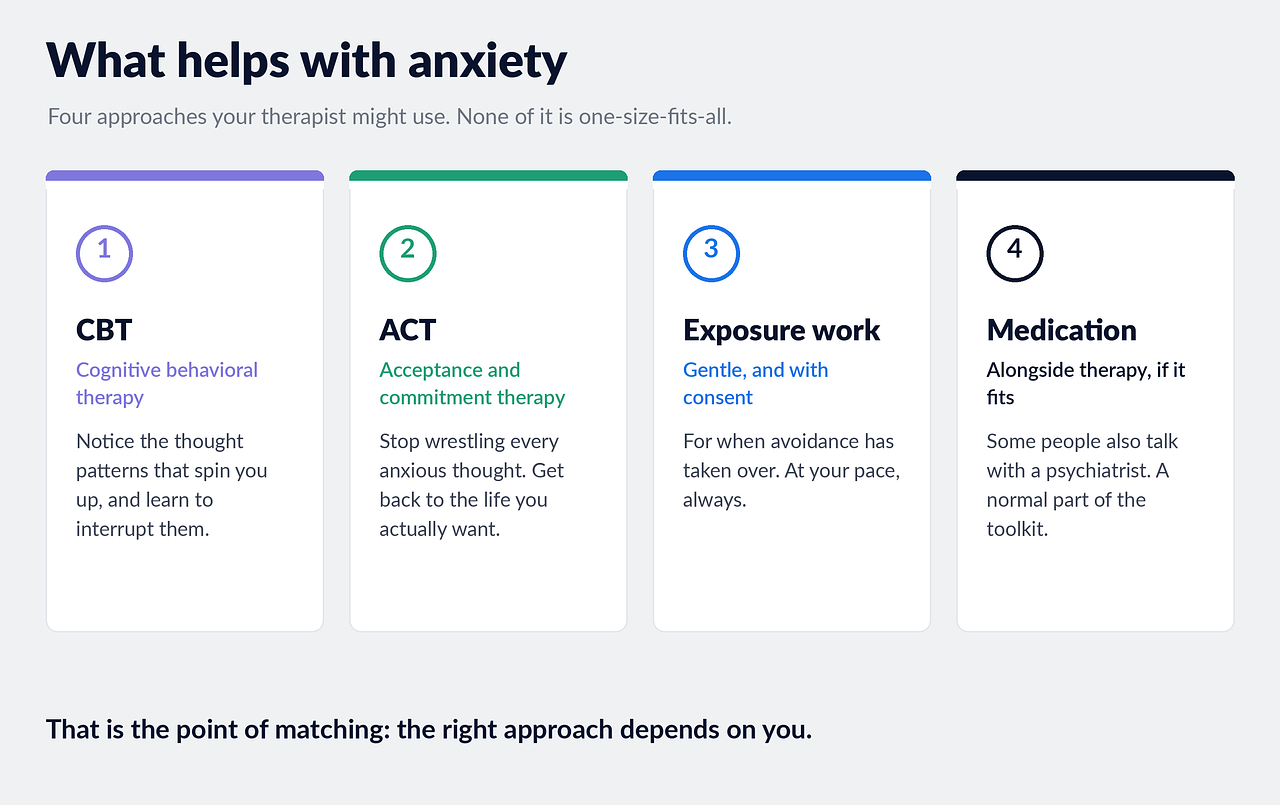
Anxiety is your threat system doing its job too well. But where anxiety used to go on high alert when you walked down a dark alley, now it gets turned on right after you leave a social gathering with your friends. That's not helpful, it's overdrive. Therapy is less about switching it off and more about renegotiating with it. Cognitive behavioral therapy, CBT, is the most studied approach, and it's practical: you learn to catch a spiral mid-spin ("if I bomb this presentation, my career is over") and test it against something truer ("one presentation is one presentation"). Interrupting that pattern sounds simple but it takes practice, and that's where therapy can help the most. Acceptance and commitment therapy, ACT, tends to fit people who are worn out from wrestling every anxious thought; you practice putting the rope down. Exposure work, done gently and with your consent, helps when avoidance has started drawing the map of your life. Some people also add medication through a psychiatrist. What helps depends on you, which is the honest reason matching matters.
The first sessions are mostly introductions, maybe talking through recent real-life moments that gave you those anxious feelings. Therapists on our platform will tell you that people open with "I don't know where to start" every single week. It's a fine way to start.
The search is the worst part
For an anxious person, the search itself is a barrier. A thousand profiles. Cold emails to strangers. Fifteen-minute intro calls where you try to read a stranger through their phone voice… it's a gauntlet, and it quietly filters out the people who need the least friction.
The Match skips it. One intake about what you're looking for. We match you with California therapists who fit, including therapists who spend most of their week treating anxiety, and you see why you were matched. Then nothing happens until you decide it does. Nobody contacts you first. No therapist even sees your name unless you reach out. If pace and control matter to you right now, that's the point.
Not ready for therapy? That's allowed.
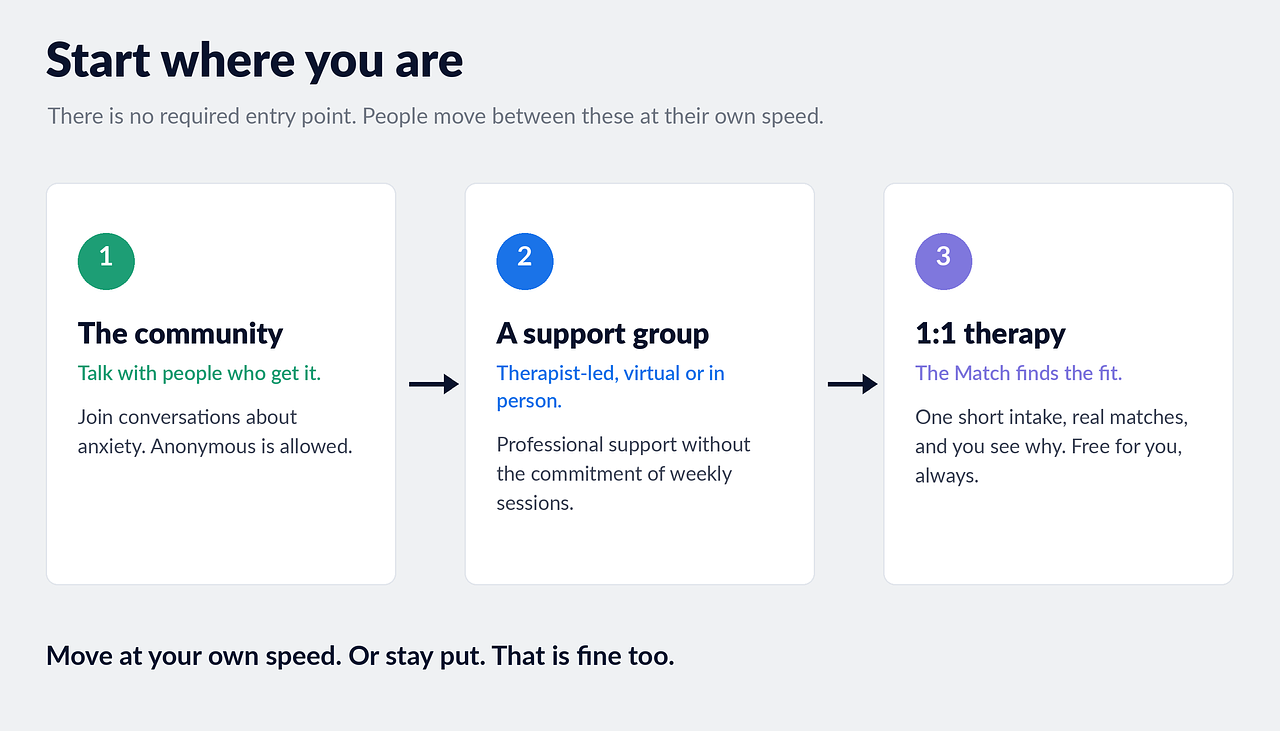
saymore is a community first. There are conversations about anxiety happening right now between people who get it, and you can join anonymously if a name feels like too much. Therapist-led support groups, virtual or in person, sit in the middle: professional support without the weekly commitment. People drift between all of these at their own speed. Some end up in therapy. Some stay in the community for good. Both count. Maybe the first step is seeing that other people feel this too and there's a light at the end of the tunnel.
From the saymore blog
Our founder writes about this from the inside, not the podium. Start with how to stay hopeful when it all feels heavy, what a month off social media did for her mind, and the tiny moments of care that hold us together.