How do I find a therapist who takes my insurance in California?

Start with your plan, not the directory. Call the behavioral health number on your insurance card, find out what your mental health benefits actually are, and get the in-network list. Then narrow that list by fit. It takes more steps than it should, but California law gives you more backup here than most people realize.
Who's actually in charge of your mental health coverage
It isn't always the company on your card. Many plans hand mental health off to a separate behavioral health company, so the list on the main insurer's website may not be the one that counts. Look for a behavioral health or mental health number on your card, or call member services and ask who manages it.
A few questions worth asking on that call:
- Do I have in-network and out-of-network mental health benefits?
- What's my copay or coinsurance for outpatient therapy, and do I have to meet a deductible first?
- Do I need a referral or preauthorization?
- Is telehealth covered the same way as in-person?
- If I see someone out of network, how much do you reimburse for a 60-minute session (billing code 90837) or a 45-minute one (90834)?
Write down the date and the name of the person you spoke with. It helps later if anything gets disputed.
Why the in-network list lets people down
Provider lists are often out of date. You'll call names who've stopped taking new clients, left the network, or never call back. It's frustrating and common, and it isn't a sign you're doing it wrong. It's also where the next section comes in.
The California rules that back you up
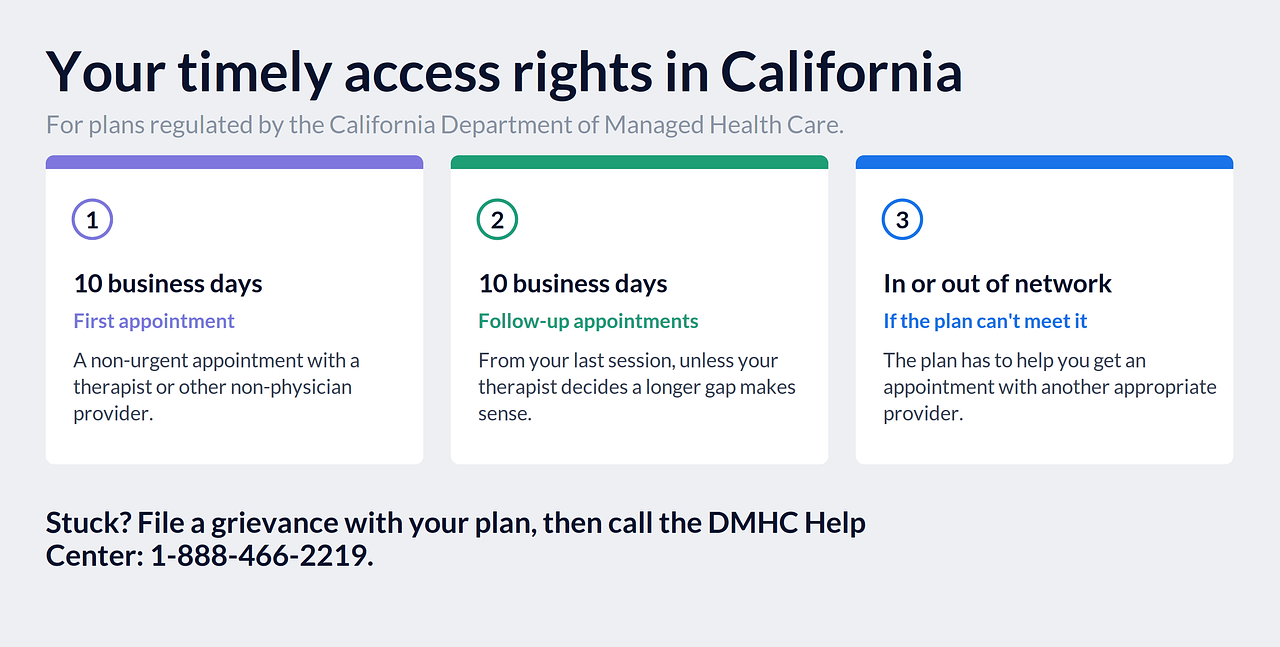
If your plan is regulated by the California Department of Managed Health Care, which covers most HMOs and many other plans, it has to offer you a non-urgent appointment with a non-physician mental health provider, like a therapist, within 10 business days of your request. If it can't, it has to help you get an appointment with another appropriate provider, in or out of network.
Since July 2022, plans also have to offer follow-up therapy appointments within 10 business days of your last one, unless your therapist decides a longer gap makes sense. And since 2021, California has required plans to cover medically necessary mental health treatment based on generally accepted standards of care, not an insurer's own narrower rules.
Not every plan falls under these rules. Some employer plans are self-funded and regulated federally instead, so ask your plan or HR which applies to you. If a state-regulated plan won't get you a timely appointment, file a grievance with the plan first, then contact the DMHC Help Center at 1-888-466-2219.
Going out of network
Plenty of good therapists don't take insurance at all. If your plan has out-of-network benefits, you pay the therapist directly, they give you a superbill (a detailed receipt with the codes your insurer needs), and you submit it for partial reimbursement. Check your out-of-network deductible first. It's often higher than people expect, and it resets every plan year.
If cost is the real barrier
- Sliding scale. Many private-practice therapists keep a few lower-fee spots. It's completely fine to ask.
- Associates. Pre-licensed clinicians working under a licensed supervisor often charge less.
- Community clinics and university training clinics, which often set fees by income.
- Medi-Cal. It covers mental health care. Depending on what you need, care runs through your Medi-Cal plan or your county's mental health plan, and you can start with either one.
Where The Match fits
Insurance and budget are part of the intake. You tell us your plan or what you can spend, and that fit is part of the match, alongside specialty, approach, and identity, so you're not falling for a profile only to find out it's out of reach. You see why each therapist came up, including the practical details. It's free for you, always.
A note on this page