What kind of therapist do I need?

Probably a simpler answer than the internet suggests: for most people, most of the time, you need a licensed talk therapist whose specialty covers what you're carrying and whose way of working suits how you process things. You don't need to know the right acronym, and you don't need a diagnosis to start. The sorting-out is the therapist's job, not the entry fee.
The question behind the question
Nobody actually wonders about license types at 1 a.m. The real question is usually "something's wrong, and I don't know what category it goes in." Can't sleep. Can't focus at work. Fine all day and hollow at night. Fighting with someone you love about nothing. That's not a failure to self-diagnose. That's the normal starting condition, and every therapist has heard it said exactly that vaguely, hundreds of times.
The alphabet, translated
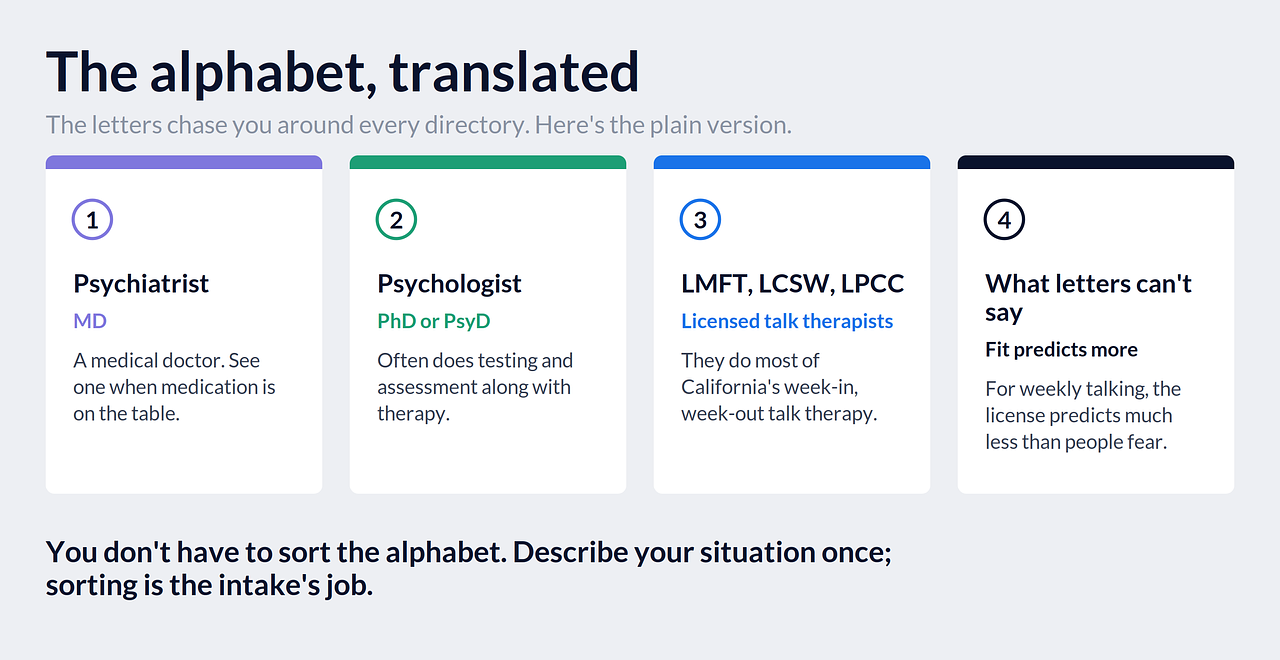
Since the letters will chase you around every directory, here's the plain version. Psychiatrists (MD) are medical doctors; see one when medication is on the table. Psychologists (PhD or PsyD) often do testing and assessment along with therapy. LMFTs, LCSWs, and LPCCs are the licensed therapists who do most of the week-in, week-out talk therapy in California: marriage and family therapists, clinical social workers, and professional clinical counselors. The training paths differ. In the room, for weekly talking, the license predicts much less than people fear. Fit predicts more.
What actually matters when choosing
Three things, roughly in order. Specialty: someone who spends real clinical time with what you're facing, whether that's anxiety, depression, grief, a relationship, or the uncategorizable heaviness. Way of working: some therapists are structured and practical, with skills and homework; others are exploratory and let the hour breathe. Neither is better, but most people have a clear preference once they've felt both. And logistics: fee, insurance, schedule, in person or virtual. Logistics sound unromantic until they're the reason therapy quietly stops.
Once you're actually in a room with someone, the good-fit guide covers how to tell whether the fit is working.
How long does this usually take?
Real-world ranges: doing it by directory, people commonly spend a few weeks between the first search and the first session, sometimes longer when emails go unanswered or the promising ones aren't taking new clients. The search is usually the slowest part, which is also why it's the part worth automating. An intake-based match compresses it to the time it takes to answer questions about yourself. After that, the timeline is mostly availability and your own readiness, and giving the new person three to five sessions before you judge the fit.
Who can help you figure it out
If you want a human to think alongside: your primary care doctor can rule out the medical lookalikes (thyroid, sleep, medication side effects) and refer. Any licensed therapist will do a consult call, and they refer sideways constantly; asking "do you work with people going through this?" is a normal first question, not an imposition.
Or let the intake do the sorting. The Match was built for exactly this moment: you answer questions about what you're carrying, how you communicate, and what you can spend, in plain language, no acronyms required. California therapists on the platform have answered their own intake about how they work and who they work best with, and the match runs on both sides, including specialty, approach, identity, and insurance and budget fit. You see who fits and why, nobody contacts you first, and it's free for you, always.
If you're in California
One practical note for here at home: California licenses the therapist types above through state boards, and directories will show you all of them mixed together. You don't have to sort them. Describe your situation once, and let the sorting happen on the other side of the intake, where the information actually lives.
A note on this page