If “just try harder” never worked, there may be a reason

It's 4:40 on a Thursday, and the thing that was due Monday is still open in a tab, next to the email you meant to answer, next to the form you need before you can fill out the other form. You haven't been idle. You've been busy all day, mostly with the wrong things, and now the guilt is louder than the task. Tonight you'll finish it in a late burst of panic, do it well, and promise yourself you'll start earlier next time.
If that rhythm has run most of your life, you may be one of the many adults who start wondering about ADHD at 28, or 35, or 50. Sometimes it's after a child's diagnosis. Sometimes a friend describes their own brain and it sounds uncomfortably like yours.
This is where we come in. saymore created The Match, an online tool where we do the heavy lifting for you. One intake about what you're carrying, how you like to work, and what you can spend, and we match you with a California therapist who also answered questions about themselves, how they work, and how they can help. It's free for you, always. Therapy is one part of ADHD care, and we'll get to the other parts below. And if therapy feels like too big a first step, you don't have to start there.
My partner has ADHD and one thing I have learned rather quickly is that it does not look the same on everyone. I thought people with ADHD just couldn't focus, which is part of it at times, but there is a lot more. What I have learned the most about ADHD is that there are many strengths that those with ADHD have that aren't celebrated as opposed to a neurotypical brain like myself. We are just different, and different does not mean bad.
Finding out as an adult
You're in large company. A 2023 CDC survey found that about 6 percent of US adults, roughly 15.5 million people, have a current ADHD diagnosis, and more than half of them were diagnosed at 18 or older.
A diagnosis in adulthood tends to bring two feelings at once. Relief, because there's finally a reason for the missed deadlines and the lost keys and the report cards that said “so bright, if only she applied herself.” And something closer to grief, for the years spent believing the problem was your character. Both make sense, and it's common to carry both into a first session. (Some people also bring a little anger. That's allowed too.)
For some adults, a diagnosis also brings a kind of grief for the version of themselves they spent years misunderstanding: the missed opportunities, the relationships, the self-esteem, and all the energy spent trying to meet expectations without knowing why certain things felt so hard.
The overwhelm and shame loop
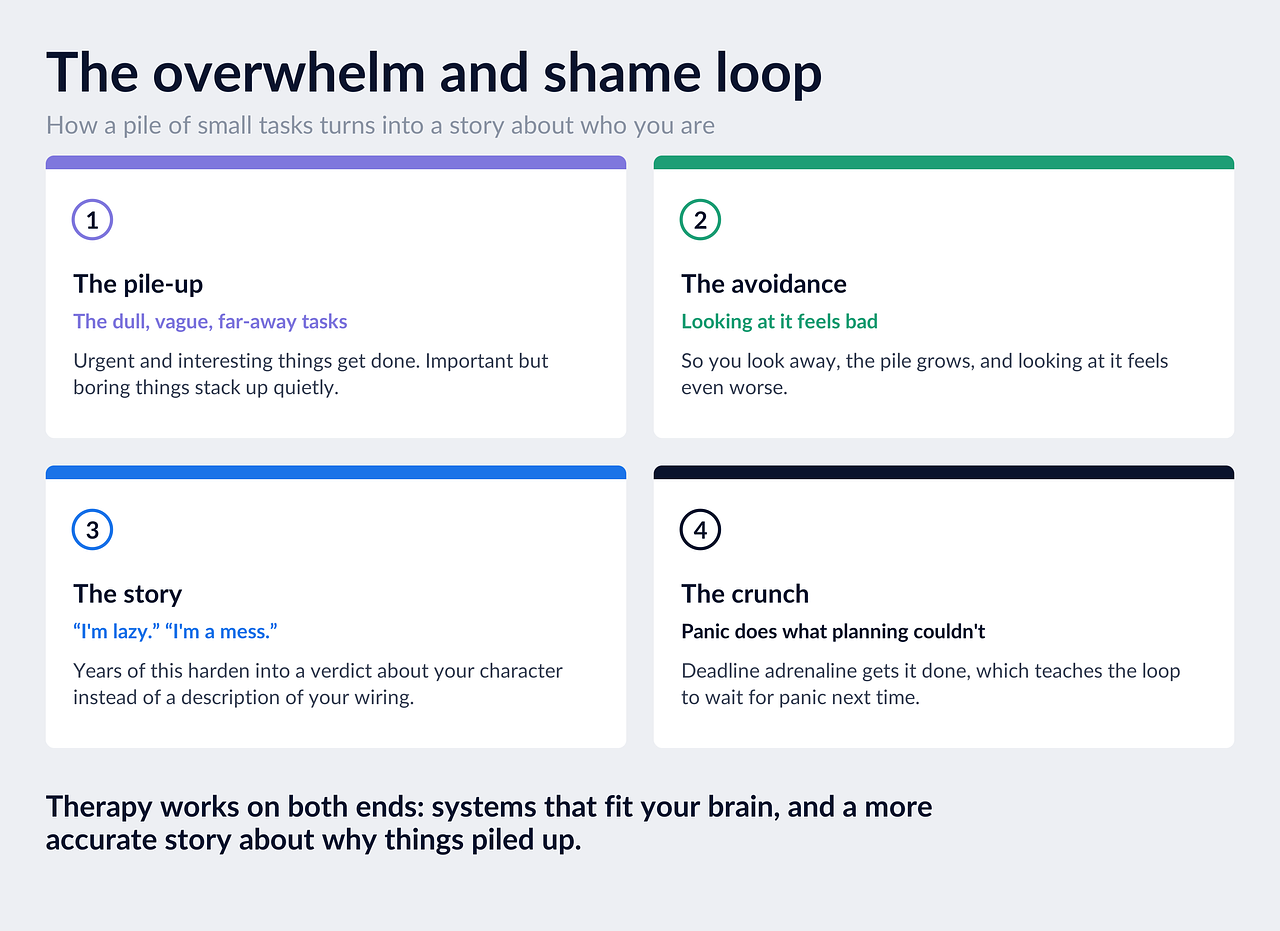
ADHD is less about having no attention and more about struggling to aim it, especially at things that are boring, vague, or far away. So the urgent and the interesting get done, and the important-but-dull quietly stack up. Then the stack becomes its own problem. You avoid the inbox because the inbox makes you feel bad, which makes the inbox bigger, which makes you feel worse.
Somewhere in there, “I'm behind” turns into “I'm lazy” or “I'm a mess,” and shame is a terrible motivator. Mostly it makes people hide. That's the loop therapy works on: the to-do list, and also the story you've built about yourself from decades of to-do lists.
Why it gets missed, especially in women
The ADHD most people picture is a boy who can't sit still. Plenty of adults, and many women in particular, live with the inattentive side of it instead: the daydreaming, the losing things, the trouble finishing, a mind that never slows down behind a calm face. CHADD, the national ADHD nonprofit, notes that girls and women have historically been underdiagnosed partly because clinicians were looking for the hyperactive version. Many also learned to compensate, working two or three times as hard to keep up, until something, a new job, a baby, a move, added one demand too many.
Many women become exceptionally skilled at compensating for their symptoms, often through perfectionism and overpreparation. From the outside they may look highly organized, like they have it all together, while inside they are working much harder than others to stay afloat.
ADHD also hides behind other labels. A large share of people with ADHD have at least one other condition alongside it, and anxiety and depression are among the most common. Plenty of adults spend years treating the anxiety or the low mood while the thing underneath goes unnamed, and sometimes it runs the other way. Sorting out which is which, and how they feed each other, is something a careful evaluation and a good therapist do together.
Related: the anxiety page, the depression page.
We also did a panel on ADHD and women. watch the panel
How do I know if it's really… ADHD?
You don't need a diagnosis to talk to someone. A few signals worth noticing, though: it's been this way since you were a kid, even if it looked different then. ADHD-related difficulties typically show up in more than one area of life, though they can look different depending on the setting, the support around you, and how much structure you have. Someone may hold it together at work because of deadlines and other people, and struggle at home. You've built elaborate workarounds, alarms and lists and backup lists, and they hold until they don't. And people who love you have said some version of “you'd be so good at this if you could just…”
A formal diagnosis comes from an evaluation, not from a single questionnaire or a social media video. That usually means an interview about your history from childhood on, rating scales, and sometimes input from someone who's known you a long time. A range of licensed clinicians can diagnose ADHD, and a medical exam can rule out things that look similar, like thyroid problems.
What therapy actually looks like
Therapy for adult ADHD tends to be practical. Cognitive behavioral therapy built for ADHD focuses on daily life: planning, getting started, managing time, and the thoughts that get in the way. A concrete example: “I have to finish the whole thing tonight or I've failed” becomes “I'll open the document and write the first heading, then decide.” That's a smaller door, and smaller doors get walked through. Alongside that comes skills work that fits how your brain actually runs, like reminders that live outside your head, a to-do list you can see, breaking big tasks into pieces with clear first steps, and working next to someone else when starting alone won't happen.
Therapy also works on what a planner can't touch: the shame, the anxiety and low mood that often ride along, rejection that lands harder than it seems like it should, and relationships worn thin by years of forgotten plans. Research suggests CBT helps whether or not someone takes medication. Medication and therapy tend to do different jobs, and they can improve overlapping parts of daily life, so for many people the two complement each other, depending on what they need.
For many adults diagnosed later in life, therapy also involves rebuilding their relationship with themselves. Years of being told they're lazy, careless, or not trying hard enough can leave deeply ingrained beliefs about what they're capable of.
Therapy, coaching, and medication
These get mixed up a lot, and most people end up with some combination. The short version:
| Who provides it | What it's good for | Insurance | |
|---|---|---|---|
| Therapy | A licensed clinician, like an LMFT, LCSW, LPCC, or psychologist | Skills and systems, plus the shame, anxiety, low mood, and relationships that come with ADHD | Often covered, depending on your plan |
| ADHD coaching | A coach (coaching isn't a licensed profession) | Goals, structure, and week-to-week follow-through | Often not covered |
| Medication | A psychiatrist, primary care doctor, nurse practitioner, or physician assistant | Evaluating, prescribing, and adjusting medication if you want it | Usually covered, depending on your plan |
Therapists on saymore don't prescribe. If medication is part of your plan, your therapist can work alongside whoever prescribes it, and a good one will talk about it plainly, without pushing it or dismissing it.
Neurodivergent-affirming, and what that means here
A neurodivergent-affirming therapist treats ADHD as a different way of being wired, with real costs and some real strengths, rather than a character flaw to correct. The goal is a life that works with your brain. That still means working on what's hard, the missed bills, the strained relationships, the exhaustion of holding it together all day. Affirming care takes the hard parts seriously. You just don't spend your sessions apologizing for being you.
A few fair questions for a first call:
- How much of your practice is adults with ADHD?
- How do you work with ADHD, and what does a typical session look like?
- How do you coordinate with a prescriber if I'm on medication or thinking about it?
- Do you do ADHD evaluations, or can you refer me to someone who does?
Related: what kind of therapist do I need, the good-fit guide.
Where The Match fits
For an ADHD brain, a therapist search is close to the worst possible task: vague, dull, many steps, no deadline. It's exactly the kind of thing that sits in a tab for six months. The Match turns it into one intake. (If you're going to do it, now, while this tab is still open, is a pretty good time.)
In your intake you can name ADHD, say you'd like someone neurodivergent-affirming, and share what you can spend. California therapists on the platform describe who they work with and how, and you see your matches and why each one came up. Nobody contacts you first, and nothing happens until you reach out.
CHADD is worth knowing about too. It keeps a professional directory, local chapters, and online support communities for adults and for women, and its National Resource Center on ADHD answers questions by phone.
Related: how The Match works, CHADD, CHADD online communities.
Not ready for therapy? That's allowed.
saymore is a community first. There are people there who know the 4:40 p.m. feeling, and you can post and comment anonymously if a name feels like too much today. Reading counts. Lurking counts. Some of the therapists on saymore also run support groups, virtual or in person, which can be a lower-commitment place to start: professional support without the weekly one-on-one. People drift between all of these at their own speed. Some end up in therapy. Some stay in the community for good. Both count.
From the saymore blog
What I learned from women with ADHD: our founder hosted a panel on it. ADHD and women, the panel And for the tired-but-did-everything-right feeling: I Built the Life I Wanted, Why Am I Still Tired?
A note on this page