A therapist you don't have to educate first

Before the first session there's often a second intake nobody sees. Do I put my partner's name on the form, or just "partner" and see what happens? Is the rainbow in their bio a commitment or a sticker? Plenty of LGBTQ+ people spend their first few sessions quietly testing a new therapist before they say the thing they came to say. That's time and energy you shouldn't have to spend.
Our founder describes it this way:
I'll never forget going to see one of my favorite queer poets with a friend of mine. On the way home, my religious friend said, "Wow, that was amazing. Too bad she is probably not going to heaven because she is gay." It is one thing to hear about homophobia, but to experience it in your life calls for a little extra mental health help, someone who understands.
She writes more about it in Dedicated to Andrea Gibson.
I did not know I was queer until I was twenty-five. My therapist helped me when I had so many questions. She was straight and did not have all the answers, but she helped me explore my identity through my own upbringing, books, and most importantly, going out there and kissing women. I think I still would have come out, but maybe much later if not for my therapist.
That story is in I Didn't "Always Know": My Late-in-Life Coming Out Story.
What affirming actually means
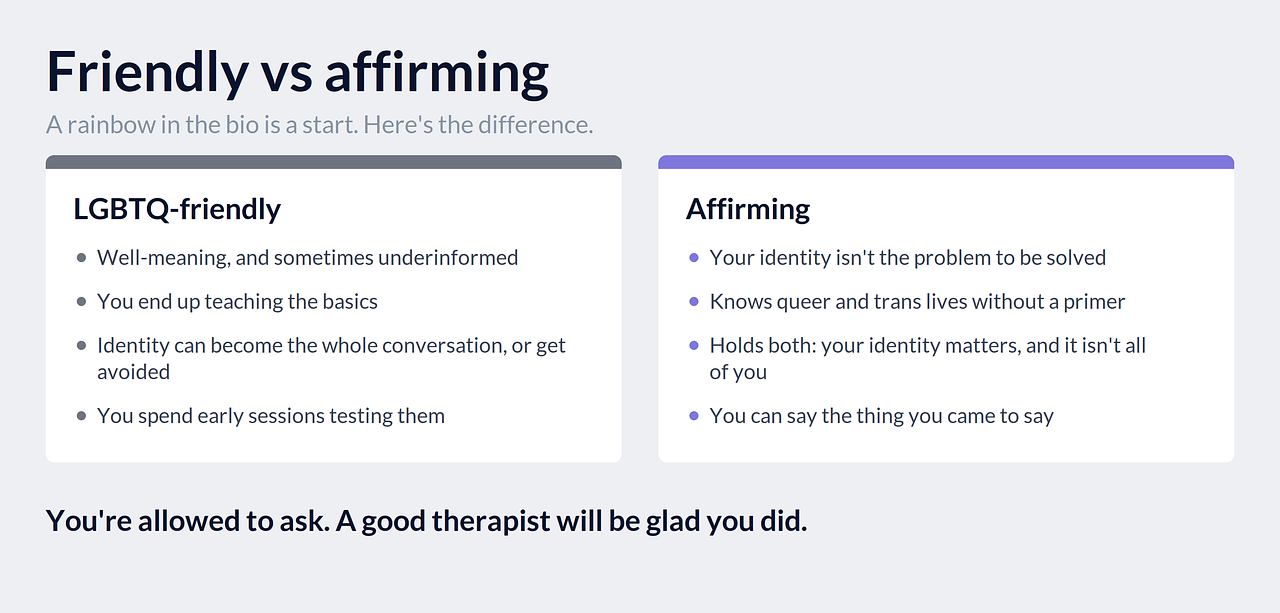
Affirming means your identity isn't the problem to be solved.
"An affirming therapist sees being gay, bi, trans, nonbinary, queer, or questioning as a normal part of human variation, something to be celebrated, and knows enough about queer and trans lives that you're not spending your hour teaching the basics."
- Brianna Winbigler, LMFT
It also means they don't make everything about your identity. Sometimes you're in therapy for grief, or work stress, or a breakup that would hurt the same for anyone. A good affirming therapist can hold both: your identity matters, and it isn't the only thing about you.
"LGBTQ-friendly" is a lower bar. Friendly can mean well-meaning and underinformed. Affirming means training, experience, and a practice where you don't have to brace yourself.
What people bring
Anything, of course. A few things come up often. Minority stress: the steady background load of anticipating rejection, or doing the math on whether it's safe to hold hands here. Coming out, or deciding not to, with family, at work, or in a faith community. Relationships and families that don't follow the default script. Gender exploration and transition, including the practical parts. And the same anxiety, depression, and trauma anyone carries, sometimes shaped by being queer and sometimes not.
What to ask on a first call
- How much of your practice is LGBTQ+ clients?
- What training have you had in working with queer and trans people?
- How do you think about sexual orientation and gender identity in therapy?
- If it's relevant to you: do you write letters for gender-affirming care, and what does that process look like?
- Anything else that matters to you, like polyamory, kink, or religious trauma: are you comfortable working with it?
You're allowed to ask all of this. An affirming therapist will be glad you did, and a hesitant answer tells you something too.
Does my therapist need to be LGBTQ+ too?
Not necessarily. Some people feel safest with a therapist who shares their identity, and that's a completely valid thing to look for. Others do great with a well-trained ally. What matters most is whether you feel understood, and most people can tell within a few sessions.
In California
California was the first state to bar licensed therapists from practicing conversion therapy with minors, in 2012. That protects young people. Adults still get to check for themselves: look up a license, ask the questions above, and trust how the first sessions feel.
The Match lets you put this where it belongs, in the intake. Identity and lived experience are part of what you can share, as much or as little as you want, and California therapists on the platform describe who they work with and how. The match runs on both sides, and you see why someone came up. Nobody contacts you first, and it's free for you.
And if you're not ready for therapy, the saymore community is open, with anonymous posting and commenting for the conversations that are easier without your name on them.
A note on this page