How do I know if a therapist is actually a good fit?

You can usually tell within three to five sessions. Not from a lightning bolt, but from smaller things: you say more than you planned to, the hour doesn't crawl, and you leave with something to chew on instead of a vague sense of having performed. Fit isn't a grade on you or your therapist. It's the overlap between what you need and how they work, and decades of research on why therapy helps keep pointing at that overlap, more than at any particular method or the letters after anyone's name.
The drive-home test
Therapists on our platform talk about the drive home. Not the session, the drive home after the session. Some weeks you'll leave rattled, because good therapy sometimes rattles. A session where you finally said the thing out loud can leave you wrung out for a day, and that's the work working. But underneath the hard weeks there's usually a quieter signal: do you feel a little more like yourself than you did in the waiting room, or are you already drafting excuses to cancel the next one?
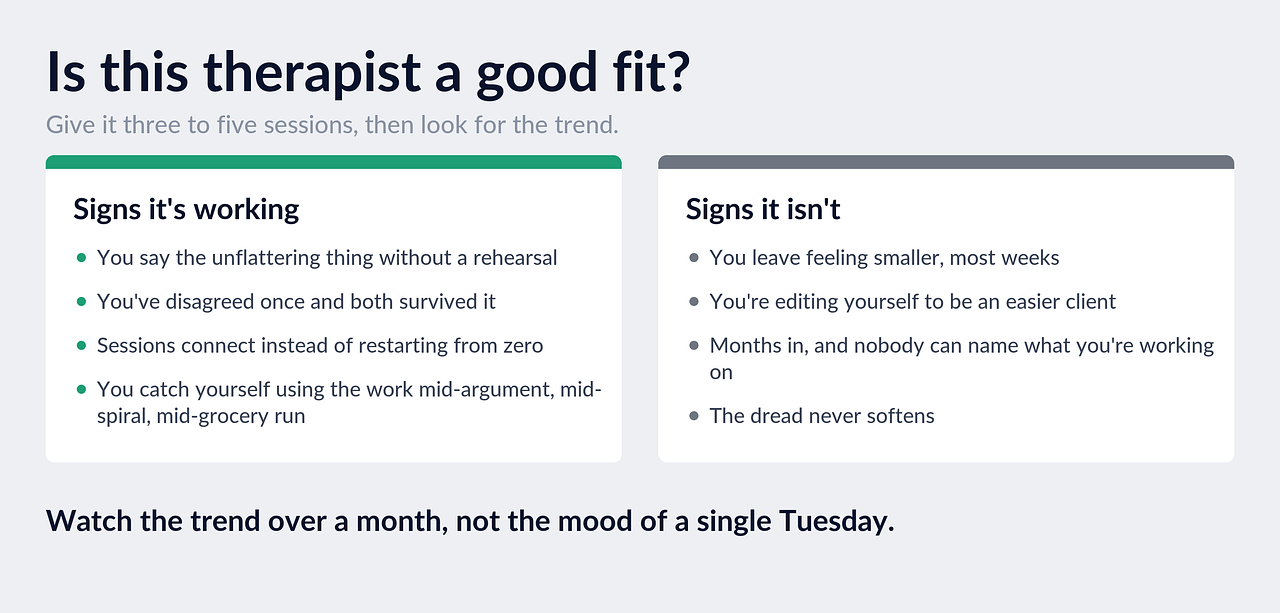
One good session doesn't mean forever. One flat one doesn't mean failure. Watch the trend over a month, not the mood of a single Tuesday.
What fit is actually made of
Some of it is practical, and you can check it before you ever meet: specialty, approach, identity and lived experience, insurance and budget, whether their openings can survive contact with your calendar. Unglamorous, and it quietly decides whether therapy is sustainable at all. A therapist you can't afford by session eight, or whose only slot is the one your boss owns, is a mismatch no matter how gifted they are.
The rest is harder to filter for. It lives in how a therapist describes their work, and whether that description sounds like relief to you or like homework. Two therapists can list the same specialty and be completely different rooms to sit in: one leans forward and gives you things to try before Thursday, the other holds long silences and waits for you to fill them. Neither is wrong. Pairing the silence-holder with someone who came for tools, though, is how two competent people end up wasting each other's Tuesdays.
When researchers ask why therapy works, the answer that keeps surfacing is the working alliance: whether you agree on the goals, agree on the how, and trust each other enough to say when either is off. Study after study finds that this alliance, measured early, predicts outcomes better than the specific method does. Which is inconvenient news for anyone hoping to solve this from a search bar.
Questions worth asking in the first session
You're allowed to interview them. Good therapists expect it, and the ones who bristle are answering a question you didn't have to ask. A few that earn their keep: What does working with you actually look like, week to week? How will we know this is helping? What do you do when something you say lands badly with a client? Have you sat with people carrying what I'm carrying?
And ask yourself one afterward: did I just perform wellness for a stranger, or did I say a true thing? The first session everyone performs a little. By the third, the performance should be getting harder to keep up, because they're making it safe to drop.
Signs it's working
You can say the unflattering thing without a rehearsal. You've disagreed with them once and both survived it, and maybe the session after the disagreement was the best one yet, which is common and a very good sign. Sessions connect to each other instead of restarting from zero. They remember your people without checking notes, or at least remember which sister is the difficult one. And every so often you catch yourself using something from the room in the middle of an ordinary day, mid-argument, mid-spiral, mid-grocery run. That last one is the whole point.
Most people who stick with a well-matched therapist notice some movement within a couple of months, though timelines vary with what you're carrying. Slow is normal. Directionless is the thing to watch.
Signs it isn't (and why that's not a verdict)
You leave feeling smaller, most weeks. You're editing yourself to be an easier client. You've been going for months and can't name what you're working on. They talk more than you do, or they've decided what your problem is and no new information seems to update it. You dread it in a way that never softens, which is different from the normal flutter of hard conversations.
None of this makes them a bad therapist, and none of it makes you bad at therapy. Some pairings just don't have the traction the work needs. Therapists know this about their own field. You will not be breaking news to them.
Say the awkward thing first
Before you quit, try one plain sentence: "I don't think we're getting where I want to go. Can we talk about that?" It's the single highest-leverage move in all of therapy, and almost nobody uses it. Therapists are trained for this conversation; there's a whole literature on rupture and repair, and repairs are where a lot of the deepest work happens. A good therapist responds by adjusting the approach, revisiting the goals, or helping you find someone better suited, and none of those outcomes is a loss for you.
And if saying it out loud feels genuinely impossible with this particular person... that's information too.
If it's still not right
Then the problem is finding the next person without repeating the gauntlet of tabs and cold emails that got you here. That's what The Match is for. One intake about what you're carrying, how you communicate, and what you can spend, and saymore matches you with California therapists who answered the same kinds of questions about themselves. You see why you were matched, nobody contacts you first, and it's free for you, always.
If you're mid-switch, the companion guide covers how to leave well and keep the ground you've gained. And if you've quit before and blamed yourself, the quitting-therapy article is for you.
A note on this page