How to switch therapists without starting over

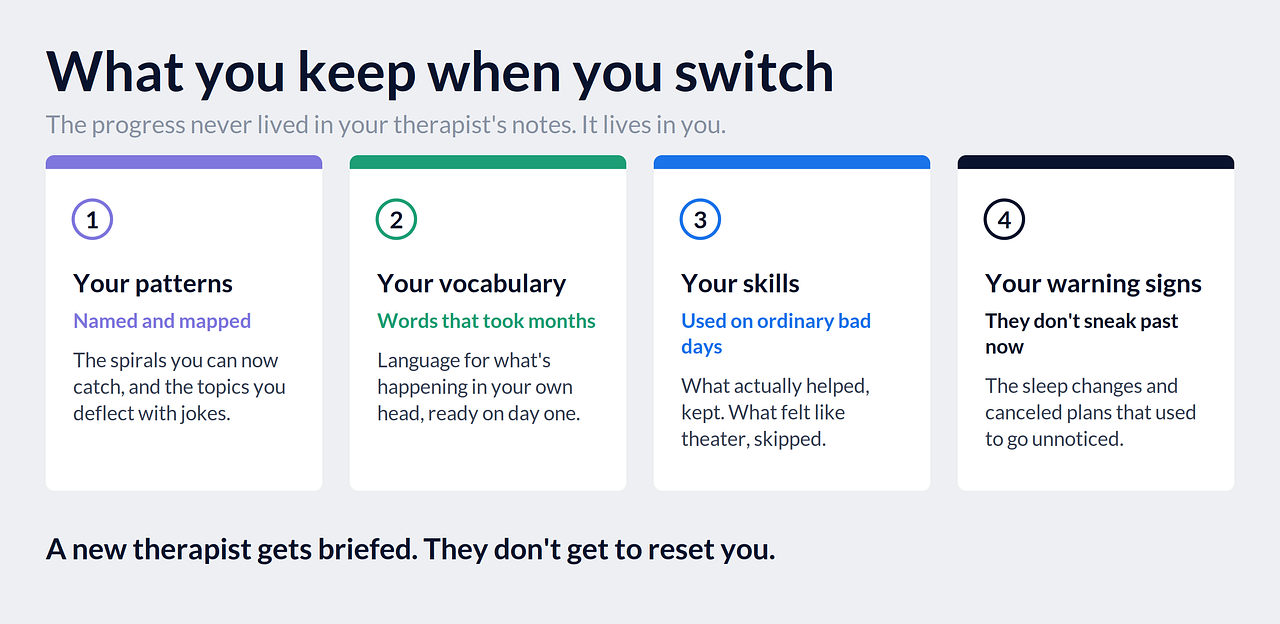
You can switch therapists without losing the ground you've gained, because the progress never lived in your therapist's notes. It lives in you: the patterns you can now catch, the vocabulary you have for what's happening in your own head, the skills you use on ordinary bad days. A new therapist gets briefed. They don't get to reset you.
The fear that keeps people stuck
Ask anyone who stayed too long with a mediocre fit, and the reason is rarely loyalty. It's the retelling. The idea of re-explaining your childhood, your marriage, the thing that happened in 2019, all of it from the top, to another stranger with a notepad... exhausting. So people stay, on the logic that a known meh beats an unknown restart.
Here's what that math misses: the first telling took months because you were figuring out the story while you told it. You're not that person anymore. The story got shorter because you've told it once.
What actually transfers
More than you'd think. You know how you respond to silence, homework, and being gently called out. You know which topics you deflect with jokes (a thing your last therapist probably named, and now you get to skip six weeks of someone discovering it). You know what helped and what felt like theater. You even know your own warning signs now, the sleep changes or the canceled plans that used to sneak past you. Therapists on our platform describe switchers as some of their fastest starts, because they arrive with a map instead of a blank page.
Most people find the second beginning moves faster than the first, though it varies with how deep the earlier work went. The awkward first session still exists. It's just shorter.
How to leave well
Tell them, if you can. You can say it in session or send it as an email; you don't owe anyone a breakup meeting. A good therapist will take it professionally, offer a referral if you want one, and give the work an ending instead of a fade. And the fear underneath, that they'll be hurt or angry: therapists end therapeutic relationships as a routine part of the job, and the good ones would genuinely rather see you matched well elsewhere than attending politely nowhere.
If words are the hard part, borrow these. In person: "I'm grateful for the work we've done, and I've realized I need a different fit. I'd like to make this our last session." By email: "Thank you for our work together. I've decided to try a different therapist, so I'm ending our sessions. If you have a referral suggestion, I'd welcome it, and if you're open to writing a brief treatment summary, I may follow up about a release." Copy, paste, edit, send. Done is better than perfect.
About that summary: with a signed release, your old therapist can send your new one a short record of what you worked on, what approaches were tried, and where you left off, so the clinical throughline arrives without you having to narrate it. Plenty of people skip this and bring their own recap instead. Both are normal, and neither is required.
How to brief the new therapist in one session
Bring the compressed version, three parts: what you went to therapy for and where that stands, what the last therapist did that helped and what didn't, and where you want to go next. That's it. Say the quiet parts too ("I left because sessions had no direction"), because your new therapist can only steer around what they can see. If writing it down first helps, do that. Nobody grades the formatting.
One caveat about timing
If you're in the middle of a crisis, mid-medication change, or in the rawest weeks of a loss, a switch adds friction at the worst moment. It can still be the right call, especially if the fit is actively hurting, but where you have the choice, most people do better switching from stable ground than from freefall. If now is the only time you've got, tell the new therapist exactly that in the first session, and let continuity of care be the first thing you two solve together.
Finding the next one, without the gauntlet
The old way to switch is to re-run the search that found you the wrong person: tabs, cold emails, intro calls where everyone's on their best behavior. The Match starts from what you've learned instead. One intake about what you're carrying, how you communicate, and what you can spend, including the preferences your last round taught you, and saymore matches you with California therapists based on how they actually describe their work. You see why you were matched. Nobody contacts you first, and no therapist sees your name unless you reach out. It's free for you, always.
See the good-fit guide for testing the new fit properly in the first month, and the quitting-therapy article if you're still deciding whether to leave.
A note on this page