What should I look for in a first therapy session?

Look for whether you felt heard, whether the therapist explained how they work, and whether you left with a rough sense of a plan, and if you're in California, saymore's The Match can do much of the fit work before you ever sit down.
Maybe you filled out the forms on your phone in the parking lot. Maybe you're in a waiting room that smells faintly of eucalyptus, rehearsing your first sentence. Either way, it helps to know a first session runs in both directions. They're getting to know you, and you're deciding whether this is someone you want to keep talking to.
You don't have to tell your whole story in fifty minutes. Nobody does.
What actually happens
Most first sessions are part conversation, part paperwork. Expect some or all of this:
- Intake forms. Contact details, some health and family history, what's bringing you in, and insurance or payment information. Often done online before you arrive.
- Informed consent. How the therapist works, what sessions cost, the cancellation policy, how to reach them between sessions, and what to do in an emergency. You'll usually sign it.
- A privacy notice explaining how your records are handled.
- A Good Faith Estimate, if you're paying out of pocket or not using insurance. Federal law requires one, and if your bill comes in $400 or more above it, you can dispute the difference.
- If the session is online, a telehealth consent and a question about where you are right now. California rules ask therapists to confirm your location at the start of each video session.
Then the talking starts. The first one can feel a little more structured than later sessions, with more questions and fewer long pauses, because the therapist is trying to get the shape of things.
Confidentiality, and where it ends
What you say in therapy stays between you and your therapist, with a few exceptions every therapist should walk you through at the start. In California, the main ones are:
- Suspected abuse or neglect of a child, an elder, or a dependent adult, which therapists are required to report.
- A serious threat of violence against a person you can identify, which California law requires them to pass on to that person and to law enforcement.
- Serious risk that you'll harm yourself, where they may act to keep you safe.
- Rare legal situations, like a court order.
If a therapist doesn't bring this up, ask. How they answer tells you a lot about how they handle the rest.
What they'll probably ask you
Questions vary, but these come up a lot. What brought you in, and why now. What you've tried so far, including past therapy. Sleep, appetite, and health. Family, relationships, and work. Alcohol and other substances. And a few safety questions, like whether you've had thoughts of hurting yourself. Therapists ask everyone those, so being asked doesn't mean they've decided anything about you.
You can answer some of it and park the rest. "I'm not ready to get into that yet" is a complete answer, and a good therapist will take it as one.
What to look for
By the end of the hour, you're not looking for a breakthrough. You're checking a few quieter things:
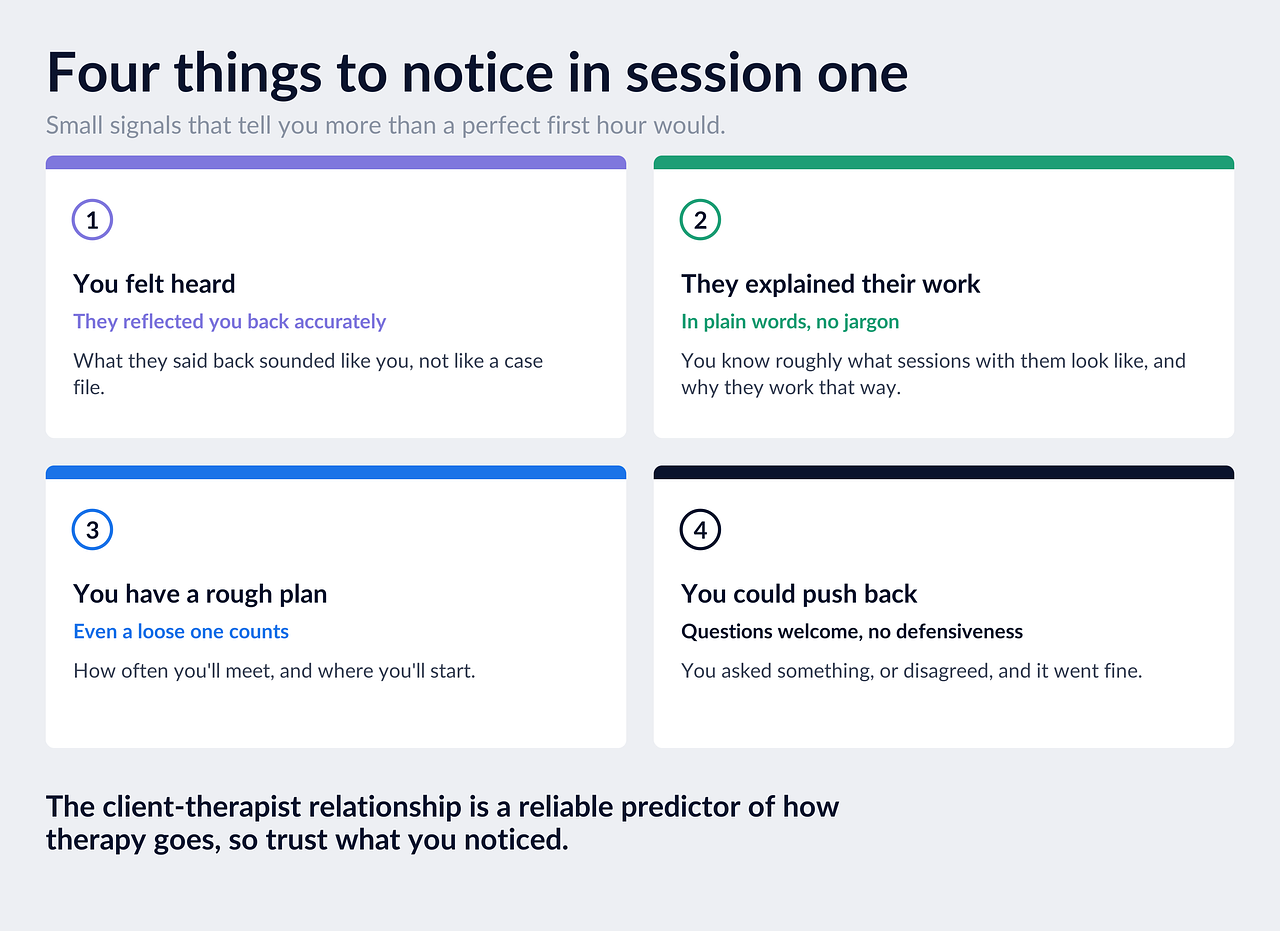
- Did you feel heard? When they reflected back what you said, did it sound like you?
- Did they explain how they work, in plain words, and what sessions with them tend to look like?
- Do you leave with some sense of a plan, even a loose one, like how often you'll meet and where you'll start?
- Could you ask questions, or push back, without them getting defensive?
- Did the pace feel okay, neither rushed nor drifting?
The first one carries the most weight. A 2018 meta-analysis of 295 studies covering more than 30,000 clients found the working relationship between client and therapist was a reliable predictor of how therapy turned out, across different approaches and in both face-to-face and online work. You can't measure that in one session. You can usually tell whether it has a chance.
Green flags and yellow flags
Green flags:
- They explain confidentiality and its limits without you having to ask.
- They're clear about fees, cancellations, and how to reach them.
- They ask what you want from therapy, not only what's wrong.
- They say what they don't know, or mention when someone else might be a better fit.
- You left feeling a bit more understood, even if the hour was hard.
Yellow flags, worth noticing and maybe asking about:
- They talked about themselves more than about you.
- They seemed distracted, kept checking the clock, or ran late without a word.
- They couldn't say how they work, or got vague about fees.
- They pushed a long commitment before knowing much about you.
- You felt judged, or caught yourself performing being okay.
A few things aren't yellow at all: romantic or sexual comments, pressure to meet outside of therapy, or asking you for favors. Those are ethics violations. You can stop seeing that therapist and report it to the board that licensed them, which in California is the Board of Behavioral Sciences or the Board of Psychology.
Questions to ask them
You're allowed to interview your therapist. Most of them expect it.
- How would you describe the way you work?
- What does a typical session with you look like?
- Have you worked with people dealing with what I'm dealing with?
- How will we know if this is helping?
- How often would we meet, and for roughly how long?
- What do you charge, do you take my insurance, and what's your cancellation policy?
- Do you see clients online, in person, or both?
Related: online vs in-person therapy.
The free consultation call
Many therapists in private practice offer a short, free phone or video call before the first real session, often around fifteen minutes. You don't need to tell your story on it. Use it for logistics and a gut check: do their answers to a couple of the questions above make sense to you, and does their voice sound like one you could talk to every week? If a therapist doesn't mention one, it's fine to ask.
Where you found them shapes session one
How you got to the first session changes what you already know walking in. Here's how the most common routes compare.
| Directory (Psychology Today) | Booking platform (Grow Therapy, Headway) | The Match by saymore | |
|---|---|---|---|
| How you find them | Search and filter a large directory of profiles yourself. | Filter by insurance, state, and specialty, then pick from therapists with open times. | Answer one intake. California therapists who fit come to you, with the reasons why. |
| Who does the fit work | You do, by reading profiles and reaching out. | Mostly you, with filters and the platform's suggestions. | The match does the first pass, using both sides' intakes. You make the final call. |
| Cost to use it | Free to search. | Free to use. You pay per session: Headway says most clients pay $20 to $50 with insurance, and Grow says copays average about $21. | Free for you, always. saymore never takes a cut of your sessions. |
| Insurance | Listed on each profile. You confirm it with the therapist. | Built in. Headway requires an in-network plan; Grow also offers self-pay. | Insurance and budget fit are part of the match. |
| Booking the first session | You call or email, then schedule with the therapist. | Book online from the therapist's calendar, often within days. | You reach out to the matches you choose. Nobody contacts you first. |
| What you know walking in | Their profile, in their own words. | Their profile, their availability, and often an upfront cost estimate. | Their profile and why you were matched. |
| Good at | Breadth. If you know exactly what you want, you can find it. | Speed and insurance. Getting in network, fast. | Fit, when you don't want to sort profiles alone. |
None of these changes the first session itself. The questions above work the same everywhere. What changes is how much of the sorting is already done, and who did it.
Related: matching vs a directory.
If it isn't a fit
It's fine if the first therapist isn't the one. Switching is common, and therapists know it. If something felt clearly off, you don't owe anyone a second session. If it was just a bit flat, two or three sessions is a fair trial, since a first session is mostly intake and the real texture shows up later. Either way, you can say it plainly: "I don't think this is the right fit for me." A good therapist will take that in stride, and some will suggest someone who might fit better.
Related: how to switch therapists, the good-fit guide.
Where The Match fits
In California, The Match handles the part of the search that usually happens before any of this. You answer an intake about what you're carrying and how you like to work, California therapists on the platform answer their own, and you see who fits and why: specialty, approach, identity and lived experience where it matters to you, and insurance and budget fit. You reach out when you're ready. Your intake stays active, so if the first match isn't the one, new matches can surface, and you can contact any of your matches at any time. It's free for you.
If one-on-one therapy feels like a big first step, some of the therapists on saymore also run support groups, virtual or in person, which can be a lower-commitment way in.
Related: how The Match works.
A note on this page