How do I find the right therapist in California?

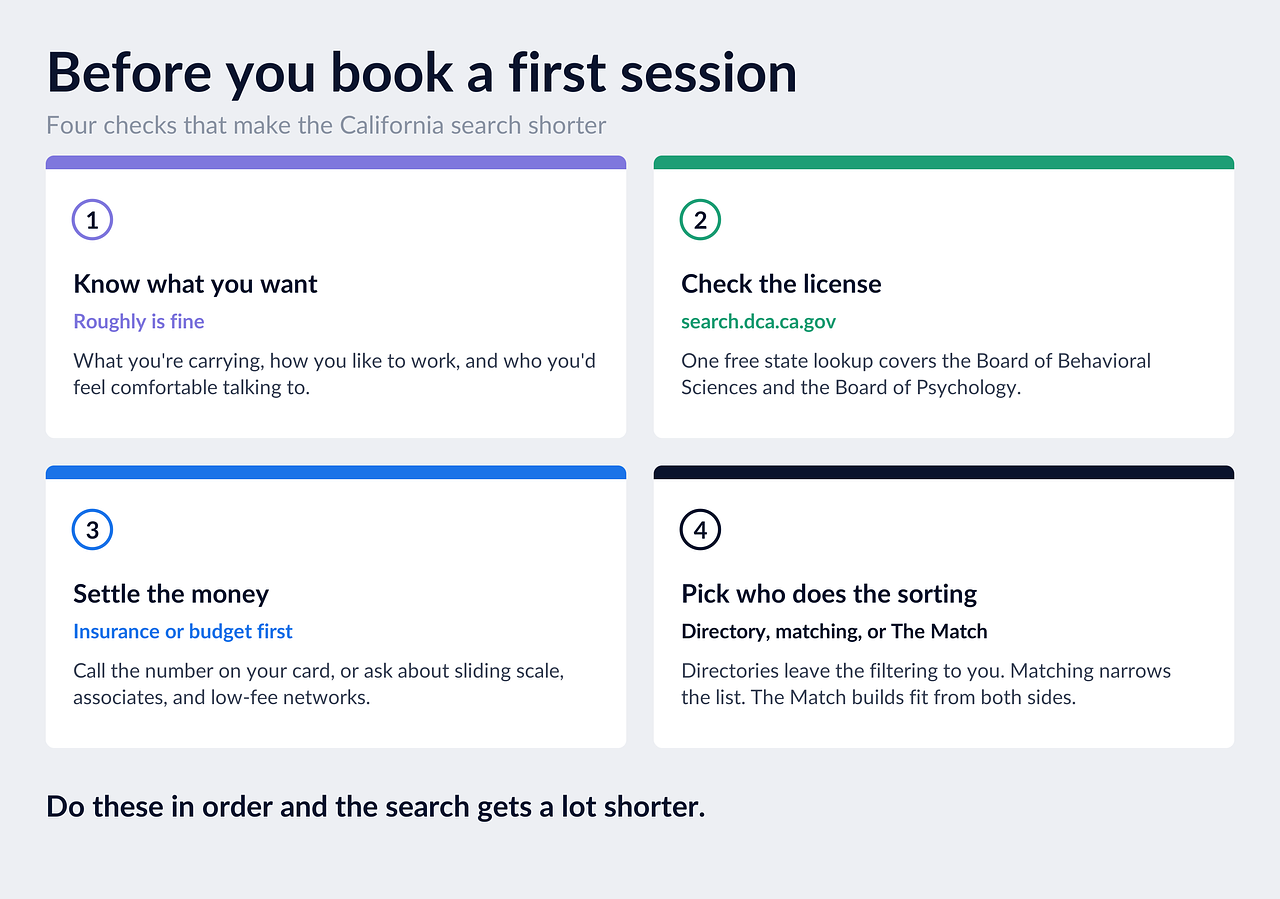
Get clear on what you want help with, check the therapist's license on California's free state lookup, settle insurance or budget, then choose how to search: a directory like Psychology Today, a matching service, or saymore's The Match, which does the fit work for you.
Most people do it in the opposite order. They open a directory, scroll until the faces blur, email three strangers, and find out a week later that one is full, one doesn't take their plan, and one never wrote back. None of that means you're bad at this. The search is built backward.
Our founder has written about why this is harder in California than it should be, and what actually helps.
Related: Finding the Right Therapist in California Is Harder Than It Should Be, Why Finding the Right Therapist in California Is So Hard (And What Actually Helps).
Know what you're looking for (roughly is fine)
You don't need clinical vocabulary to start. You need a rough sense of a few things. What's going on: anxiety that won't let you sleep, a relationship that's gone quiet, grief, a diagnosis you already have, or just "I don't feel like myself." How you like to work: someone practical who gives you things to try between sessions, or someone who lets you talk and follows the thread. And who you'd feel comfortable with, whether that's about gender, age, culture, faith, language, sexuality, or a therapist who already understands something you've lived through.
If you're not sure what kind of therapist fits what you're carrying, that's its own question, and we wrote a guide for it.
Related: what kind of therapist do I need, culturally competent therapists.
Check the license. It takes about a minute.
In California, therapists are licensed by two state boards. The Board of Behavioral Sciences licenses marriage and family therapists (LMFT), clinical social workers (LCSW), professional clinical counselors (LPCC), and educational psychologists, plus the associates working toward those licenses. The Board of Psychology licenses psychologists. Both boards point you to the same free tool, the Department of Consumer Affairs License Search.
Search by name and confirm the license is current and in good standing. If you see a title like Associate Marriage and Family Therapist, that's someone who has finished their degree and is completing supervised hours toward full licensure. Associates are legitimate, they're supervised, and they often charge less. Nobody gets notified that you looked, and a good therapist would want you to.
Related: DCA License Search, counselor vs therapist for what the letters after a name mean.
Sort out the money before you fall for a profile
If you're using insurance, call the behavioral health number on your card first. Ask for the in-network list, your copay or coinsurance, and whether you need a referral. It's also worth knowing that if your plan is regulated by the California Department of Managed Health Care, it has to offer you a non-urgent appointment with a therapist within 10 business days of your request.
If you're paying out of pocket, ask about sliding scale fees, look at associates, or try a low-fee network. Open Path Collective, a nonprofit, charges a one-time $65 membership, and its therapists see members for $40 to $70 a session (as of October 2026). It's set up for people without insurance, or without enough coverage, who can't afford full rates.
Related: the California insurance guide.
The three ways to search
Once you know roughly what you want, the real choice is who does the sorting. There are three broad options, and each is good at something.
Directories. Psychology Today is the big one. You search by city or zip and filter by issue, insurance, cost, gender, language, ethnicity served, faith, and more. Profiles marked Verified have had a license or primary credential checked by Psychology Today. It's free to search, and therapists pay to be listed ($29.95 a month as of October 2026). The catch is that the narrowing is all yours. California also has its own directory, Counseling California, where listed therapists are approved by the California Association of Marriage and Family Therapists.
Matching services. Zencare and Mental Health Match both ask you questions first, then show you therapists who fit your answers. Zencare adds intro videos and free consultations you can book from the site, and checks that every listed provider holds an active, unrestricted license. Mental Health Match uses a clinical survey about your concerns, preferences, insurance, and schedule, then lets you browse your matches. Both are free for people looking for therapy, and both cover California along with other states.
The Match. saymore's matching runs only in California. You fill out an intake about what you're carrying, how you like to work, identity and lived experience where it matters to you, and your insurance or budget. Therapists on the platform fill out their own intake about who they work with and how. You see your matches and why each one came up. Therapists don't see you until you reach out, and new matches keep arriving as therapists join, so you don't have to start over.
| Option | Who does the fit work | Cost to you | California focus | What you see |
|---|---|---|---|---|
| Psychology Today (directory) | You do. You search, filter, and read profiles yourself. | Free to search. Therapists pay a monthly fee to be listed. | National, with large California listings by city and zip. | Every profile that fits your filters, with a Verified mark where a credential was checked. |
| Zencare (matching quiz plus search) | Shared. A quiz narrows the list, then you choose. | Free for people seeking therapy. Therapists pay to be listed. | Several states, California included. | Matched profiles, intro videos, and free consultations to book. |
| Mental Health Match (matching survey) | Shared. A clinical survey narrows the list, then you choose. | Free for people seeking therapy. Therapists pay a monthly fee. | National, California included. | Recommended matches with detailed profiles. |
| The Match by saymore | Mostly the match. Both sides complete an intake, and fit is built from both. | Free for people seeking therapy, always. saymore never takes a cut of sessions. | California only. | Your matches and why each one came up. Therapists don't see you until you reach out. |
Pricing and features as of October 2026, taken from each company's own site.
None of these is the wrong choice. If you already know exactly who you want, a directory is quick. If you'd rather answer questions than scroll, a matching service saves you time. If you're in California and want the fit work done from both sides, that's what The Match is for.
Related: matching vs directory, Zencare vs Psychology Today for the longer side-by-side comparisons.
Once you have a few names
Reach out to two or three at once instead of one at a time, so a slow reply doesn't stall the whole thing. Most therapists offer a short phone or video consult, and it's fine to ask about their experience with what you're facing, how they'd work with you, their fee, and their openings. Then give it a few sessions. The first ones are mostly introductions, and most people have a sense of fit within the first several meetings. If it isn't there, switching is normal. A good therapist won't take it personally.
Related: what to look for in a first session, the good-fit guide, switching therapists.
If therapy feels like too big a first step
You don't have to start there. saymore is also a community, with conversations about what people are actually going through, and you can post and comment anonymously. Some of the therapists on saymore also run support groups, virtual or in person, which can be a lower-commitment place to start: professional support without the weekly one-on-one. Some people start in the community and end up in therapy a few months later. Some stay in the community. Both are fine.
Related: how The Match works.
A note on this page