You're allowed to love your baby and not feel okay.
It's 3 a.m. The baby is finally feeding, the house is dark, and your phone is the only light in the room. You're searching for things you'd never say out loud: whether this much crying is normal (yours, not the baby's), why you don't feel the rush everyone promised, why your brain just flashed you a picture of the baby falling down the stairs. Everyone said this would be the happiest time of your life. Nobody mentioned 3 a.m.
Loving your baby and not feeling okay can both be true at once, and for a lot of new parents, they are. This is where we come in. saymore created The Match, an online tool where we do the heavy lifting for you. One intake about what you're carrying, how you communicate, and what you can spend, and we match you with a California therapist who also answered questions about themselves, how they work, and how they can help. It's free for you, always. And if scheduling therapy around a newborn sounds impossible right now, you don't have to start there.
In more than 20 years of working with new parents, the sentence I hear most is ‘I love my baby, so why do I feel like this?’ Acknowledging the feelings and reaching out for help is often where healing starts. You don’t have to feel this way. PMADs are very treatable.
Baby blues, or something more?
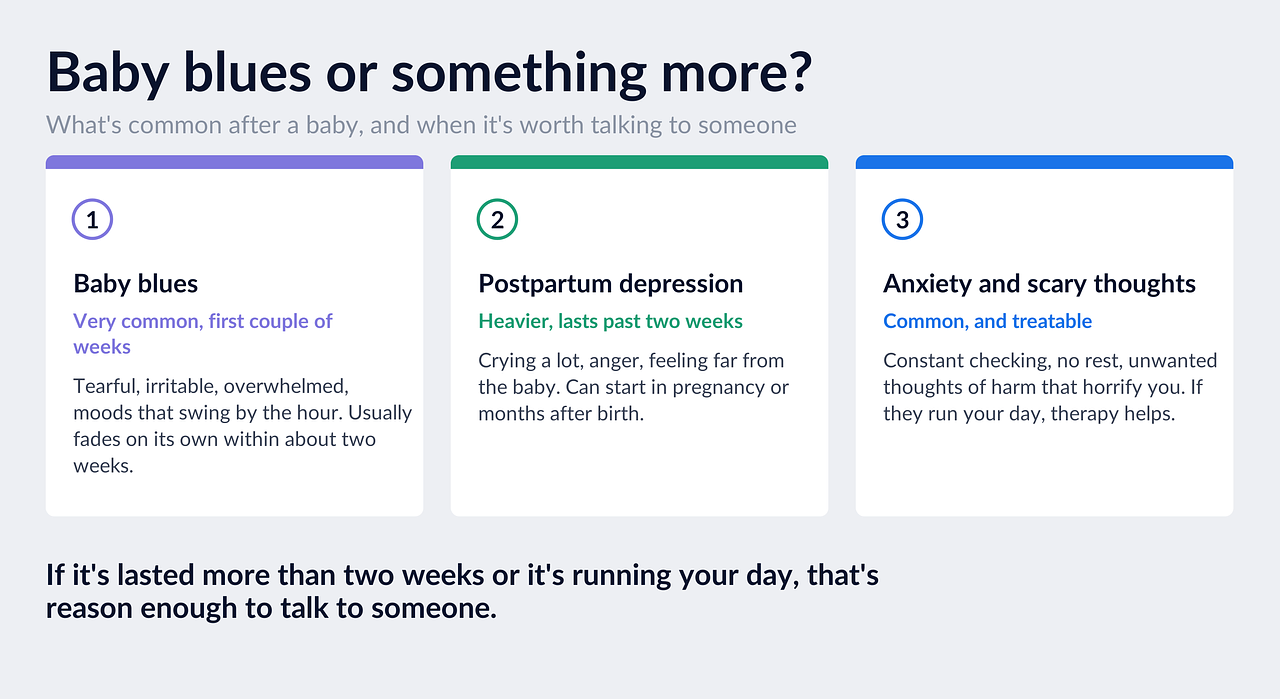
Most new parents get some version of the baby blues. Postpartum Support International puts it at around 80 percent: weepy for no clear reason, overwhelmed, irritable, a mood that changes by the hour. It shows up in the first couple of weeks after birth and usually fades on its own. That's hormones and no sleep doing what they do.
Postpartum depression is heavier, and it lasts longer than about two weeks or shows up later, sometimes months later. It can look like crying more than usual, anger that surprises you, feeling far away from the baby, or a steady voice telling you you're failing at this. About 1 in 8 women with a recent birth report symptoms of postpartum depression, according to the CDC.
Postpartum anxiety gets less airtime. It looks like checking that the baby is breathing, then checking again. Not sleeping when the baby sleeps, because someone has to stay on watch. A racing heart over ounces and feeding logs. If the worry is running the house, that counts too, even though nobody hands you a pamphlet about it.
Postpartum anxiety often hides in plain sight because it can look like being a really attentive parent. If that worry is getting in the way of sleeping or if those thoughts dominate your day, it’s worth reaching out for help.
The scary thoughts (read this part slowly)
This is the part people are most afraid to say, so here it is plainly. Most new parents have unwanted, intrusive thoughts about something bad happening to their baby. Dropping them. The car seat coming loose. Sometimes a flash of hurting the baby yourself that leaves you shaken. In a 2024 study of new mothers, about 96 percent reported intrusive thoughts of accidental harm, and more than half had at least one unwanted thought of harming their baby on purpose. Those thoughts weren't linked to any increase in aggression toward babies.
The horror you feel is a good sign. Clinicians call these thoughts ego-dystonic, meaning they run against who you are, which is exactly why they're so upsetting. For some parents, though, the thoughts get sticky. You start avoiding bath time or the knife drawer, checking and rechecking to quiet the dread, or asking for reassurance until the people around you run out of ways to give it. That pattern can be perinatal OCD, and it's treatable with a therapist who knows how OCD works.
Related: the OCD page.
Postpartum psychosis is different and rare, about 1 to 2 in every 1,000 births, and signs like seeing or hearing things that aren't there, strange beliefs, paranoia, or suddenly being unable to sleep mean it's an emergency: call 911 or go to the nearest emergency room.
Pregnancy counts. So do partners.
Perinatal means the whole stretch, from pregnancy through the baby's first year, and longer if you're nursing, and depression and anxiety can start anywhere in it. Struggling during pregnancy comes with its own special guilt, the not-glowing kind, and it deserves the same care as struggling after.
Partners go through it too. Postpartum Support International estimates about 1 in 10 dads experience postpartum depression or anxiety, and non-birthing parents of any gender aren't exempt, often while being told their job is to be the steady one. Adoptive parents go through it at similar rates, and they're often never screened because people assume it's a birth thing.
And some people are carrying this without a baby in their arms. After a miscarriage, a stillbirth, a termination for medical reasons, or a NICU stay that rearranged everything, grief and postpartum hormones can share the same body at the same time. That deserves care too.
Related: the grief page.
What therapy actually looks like (mostly: talking, sometimes with a baby on your lap)
The first sessions are mostly introductions and logistics: what's going on, how you're sleeping, who's around to help. Some therapists are fine with a baby in the room, and a video session during a nap is a legitimate strategy. Ask.
Cognitive behavioral therapy, CBT, is practical: you learn to catch the verdicts that show up at 3 a.m. (“a good mother would know why she's crying”) and check them against the actual record (“I've fed her, changed her, and held her all day, and I'm still learning her”). Interpersonal therapy, IPT, focuses on the relationships and roles that changed overnight: you and your partner, you and your own parents, you and the person you were before. Both have solid research behind them, and the US Preventive Services Task Force recommends them for people at higher risk of perinatal depression.
When intrusive thoughts have turned into OCD, therapists usually use exposure and response prevention, ERP. It sounds intimidating. In practice it means returning to the things the thoughts made you avoid, like bath time or being alone with the baby, a step at a time and with your consent, while you learn to drop the checking that keeps the fear going.
Some people also add medication. A prescriber, whether that's your OB, your primary care doctor, or a psychiatrist, can walk through options with you, including what fits if you're breastfeeding, and there's now a medication approved specifically for postpartum depression. Some prescribers also offer IV ketamine, which has had good results for postpartum depression. What helps depends on you, which is the real reason matching matters.
One credential worth knowing is PMH-C, the perinatal mental health certification from Postpartum Support International. It means a clinician has met PSI's certification standards in pregnancy and postpartum mental health. Plenty of skilled therapists don't have it, so treat it as one useful signal when you're comparing people, alongside how they talk about this work.
In California, health plans' maternal mental health programs have to include at least one screening during pregnancy and another in the first six weeks after birth, under a 2024 state law. The screening is usually a short questionnaire, most often the Edinburgh Postnatal Depression Scale. It's free and takes a few minutes, but it doesn't screen for anxiety, which is very common in new parents, and it isn't a diagnosis. A high score means it's time for a conversation with someone who knows perinatal mental health. If nobody has asked how you're doing, and meant it, you're allowed to bring it up first.
The search is the worst part
Finding a therapist with a newborn means doing research one-handed, in four-minute windows, on no sleep. Comparing profiles, sending cold emails, then playing phone tag around feeds is a lot to ask of someone who hasn't slept three hours in a row since the hospital.
The Match skips it. One intake, answered whenever you have ten minutes and a free hand. If perinatal experience matters to you, that's part of what the match accounts for, along with approach, identity, and insurance or budget fit, and you see why each therapist came up. Then nothing happens until you decide it does. Nobody contacts you first. No therapist even sees your name unless you reach out.
Related: how The Match works.
Not ready for therapy? Start smaller.
saymore is a community first. There are conversations happening right now between people who've been up at 3 a.m. too, and you can post or comment anonymously. Some of the therapists on saymore also run support groups, virtual or in person, which can be a lower-commitment place to start: professional support without the weekly one-on-one.
Postpartum Support International also runs free online support groups led by trained facilitators, including groups for dads, for queer and trans parents, for pregnancy and infant loss, and for perinatal OCD. Showing up with your camera off counts.
Related: PSI online support groups.
About the clinical reviewer
Olivia Bergeron, LCSW, PMH-C, is a psychotherapist and parent coach and the founder of Mommy Groove Therapy & Parent Coaching, where she helps parents navigate the huge changes that come with having a child, from pregnancy and postpartum through the toddler and teen years. She is licensed in New York, New Jersey, and Florida, offers parent coaching nationwide, and has been featured in The New York Times, HuffPost, and Parents Magazine.
A note on this page