What's the best way to find a culturally competent therapist in California?

Decide what you don't want to have to explain, then search where therapists say who they are: identity-focused directories like Therapy for Black Girls or Latinx Therapy, Psychology Today's language and ethnicity filters, or saymore's The Match, where identity and lived experience are part of the intake on both sides. After that, ask direct questions on a first call. A shared background helps a lot of people, but it doesn't guarantee someone gets you, and plenty of therapists from other backgrounds do this well.
You probably know the moment. You mention that you still live with your parents at 31, or that you send money to family every month, or that you pray before big decisions, and you watch the therapist decide what that means. Then you spend twenty minutes explaining your family before you can get to the part that hurts. Some people do this for months and then stop going. They didn't quit because therapy can't help. They quit because they got tired of translating.
Related: why people quit therapy.
What cultural competence looks like in the room
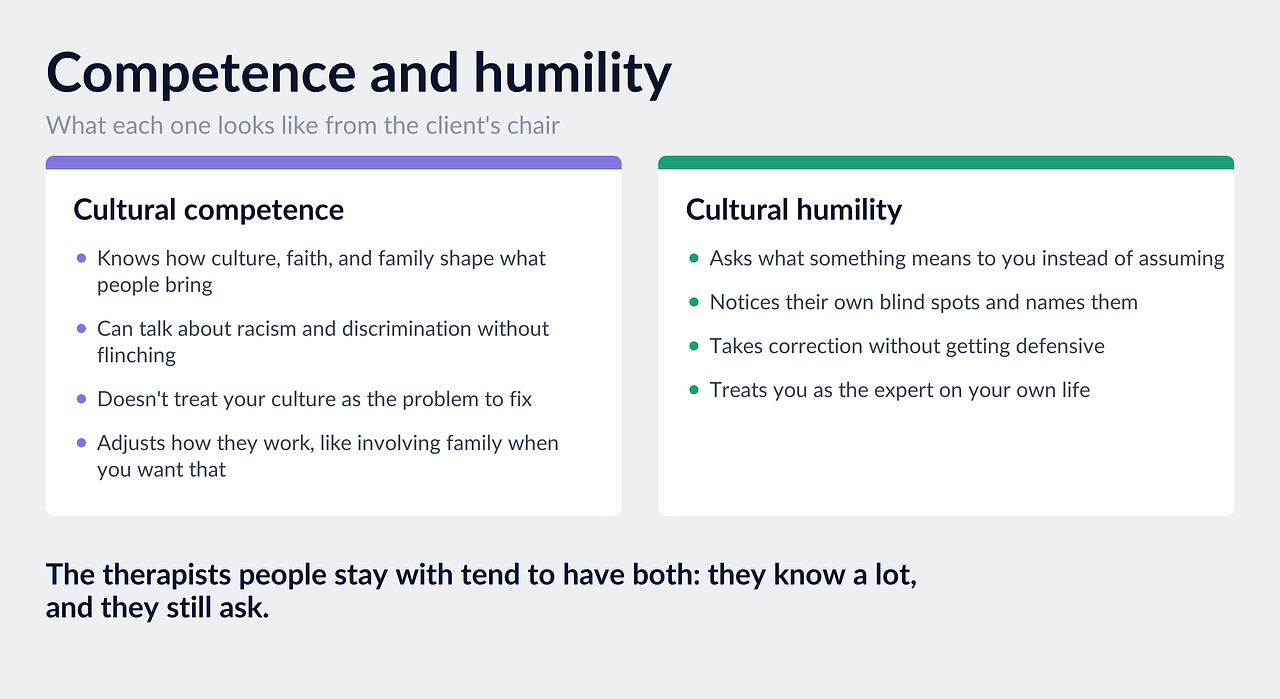
Cultural competence is a therapist's working knowledge of how culture, race, ethnicity, religion, language, class, and family history shape what people carry and how they talk about it, plus enough self-awareness to notice their own assumptions and the skill to adjust. In practice it sounds like a therapist who asks what family obligation means to you before calling it codependency, who can talk about racism without flinching or changing the subject, and who doesn't treat your culture as the problem to fix.
Cultural humility is what keeps competence from sliding into stereotype. The term comes from a 1998 paper by Melanie Tervalon and Jann Murray-Garcia, who described it as a lifelong commitment to self-evaluation and self-critique, and to addressing the power imbalance between clinician and patient. A therapist with humility knows that reading about your culture isn't the same as knowing you. They ask. They get corrected, and they say thanks.
Good cultural care also means not making everything about culture. Sometimes you're there for a breakup or a terrible boss, and a good therapist can tell when your background is central and when it's just part of the room.
Not having to translate your life
What a lot of people want is a therapist who doesn't need the backstory before getting to the point. That might be a family where big decisions are made together and moving out before marriage was never really an option. Being the oldest kid who read the mail, filled out the forms, and made the phone calls in English for everyone else. A faith that's woven into how you grieve, or into how you feel about therapy at all. The stress of having family spread across countries and time zones, or of being the first one to go to college and the one everyone's counting on.
A culturally competent therapist won't know everything about your world. They'll know enough to ask good questions, and they won't make you feel like a case study.
If faith is a big part of this for you, our faith and therapy guide goes deeper. If you're LGBTQ+, the same question of not having to educate your therapist first is the heart of our LGBTQ-affirming therapy page.
Related: LGBTQ-affirming therapy.
Therapy in the language you feel in
For a lot of people, feelings sit closer to the language they grew up with. Things you've only ever said in Spanish or Tagalog can come out flat in English, or not come out at all. California has therapists who work in Spanish, Tagalog, Vietnamese, Mandarin, Cantonese, Korean, and many other languages. Psychology Today lets you filter by language, and many Latinx Therapy profiles say when a therapist offers sessions in Spanish.
If you're using a health plan, California's language assistance rules mean you can ask for a qualified interpreter at no cost, including for counseling. An interpreter can work, though many people find therapy flows better when the therapist speaks their language directly. Some also want someone who can switch between English and their first language mid-sentence, the way they do at home.
Questions worth asking on a first call
- How much of your practice is people from my background, or people with experiences like mine?
- How do culture, race, and faith come up in your work with clients?
- What do you do when you don't understand something about a client's family or community?
- Do you offer sessions in my language, and is it your first language or one you learned?
- Have you worked with people dealing with racism or discrimination at work or school?
- If I want family involved at some point, how would you approach that?
You're allowed to ask every one of these. A good therapist will welcome it, and a vague or defensive answer is useful information too.
Where to look
Several directories exist so you don't have to guess. Here's what each one is, from their own sites, alongside the general options.
| Option | What it is | Built for | Cost to search | Who does the fit work |
|---|---|---|---|---|
| Psychology Today | The largest general therapist directory, with filters for language, ethnicity served, and faith | Anyone | Free. Therapists pay to be listed. | You do |
| Therapy for Black Girls | A national directory of therapists for Black women and girls, plus a podcast hosted by Dr. Joy Harden Bradford | Black women and girls | Free | You do |
| Latinx Therapy | A US directory of Latinx therapists, many offering sessions in Spanish, plus a podcast | Latinx people and families | Free | You do |
| Asian Mental Health Collective | A directory of more than 3,000 Asian therapists across the US and Canada, plus a free therapy fund | Asian communities | Free | You do |
| South Asian Therapists | A directory founded in 2020 to connect the South Asian diaspora with South Asian therapists; more than half are in the US | South Asian people and families | Free to browse | You do |
| Inclusive Therapists | A social justice oriented directory, founded in 2019, that vets providers on identity, qualifications, and values, with a free matching service run by people | People with marginalized identities, including BIPOC, 2SLGBTQIA+, disabled, and neurodivergent people | Free. Many members offer sliding scale. | You, or their free human matching |
| The Match by saymore | Matching built from an intake both you and the therapist complete, with identity and lived experience included | Anyone in California | Free, always. saymore never takes a cut of sessions. | The match, with the reasons shown |
Details as of October 2026, from each organization's own site. Most of these are national, so filter for California or for therapists licensed here.
Does my therapist need to share my background?
Not always. For some people a shared background is the whole point, and that's a completely valid thing to look for. Others do well with a therapist from a different background who has done the work to understand theirs. The test is whether you leave sessions feeling understood instead of studied. If you don't, it's fine to switch.
Related: switching therapists, the good-fit guide.
How The Match uses identity and lived experience
In The Match, identity and lived experience are part of the intake, as much or as little as you want to share, alongside what you're carrying, how you like to work, and your insurance or budget. California therapists on the platform describe who they work with and how in their own words. The match runs on both sides, and you see why each therapist came up. Nobody contacts you first, and it's free for you.
If one-on-one therapy feels like a lot right now, the saymore community is open, with anonymous posting and commenting, and some of the therapists on saymore also run support groups, virtual or in person.
Related: how The Match works, finding a therapist in California.
A note on this page