When you've been told it's just hormones, or just stress

You described it as carefully as you could. The week before your period when everything goes gray and you can't stand the sound of your own family chewing. The 3 a.m. wake-ups that started at 44 and never left. The feeling of running a household's entire memory in your head, every birthday and every refill. And you got a normal blood test and a kind suggestion to try yoga.
If some of that sounds familiar, you're not imagining it. saymore built The Match for people who are tired of explaining themselves from scratch, and a lot of what shapes women's mental health runs on cycles and seasons of life that a ten-minute appointment rarely has room for.
Here's how it works. The Match is an online tool where we do the heavy lifting for you. One intake about what you're carrying, how you communicate, and what you can spend, and we match you with a California therapist who also answered questions about themselves, how they work, and how they can help. It's free for you, always.
Why it can look different for women
Women aren't more fragile. They're carrying different loads, on different timelines. In CDC survey data from 2013 to 2016, women were almost twice as likely as men to report depression symptoms. Part of that is biology: mood can shift with the menstrual cycle, pregnancy, the year after birth, and the menopause transition. Part of it is the life around the biology: years of caregiving, and the experience of describing something real and being told it's normal.
This page is for women, and for anyone whose body runs on these same cycles, including trans men and nonbinary people who menstruate or are going through perimenopause.
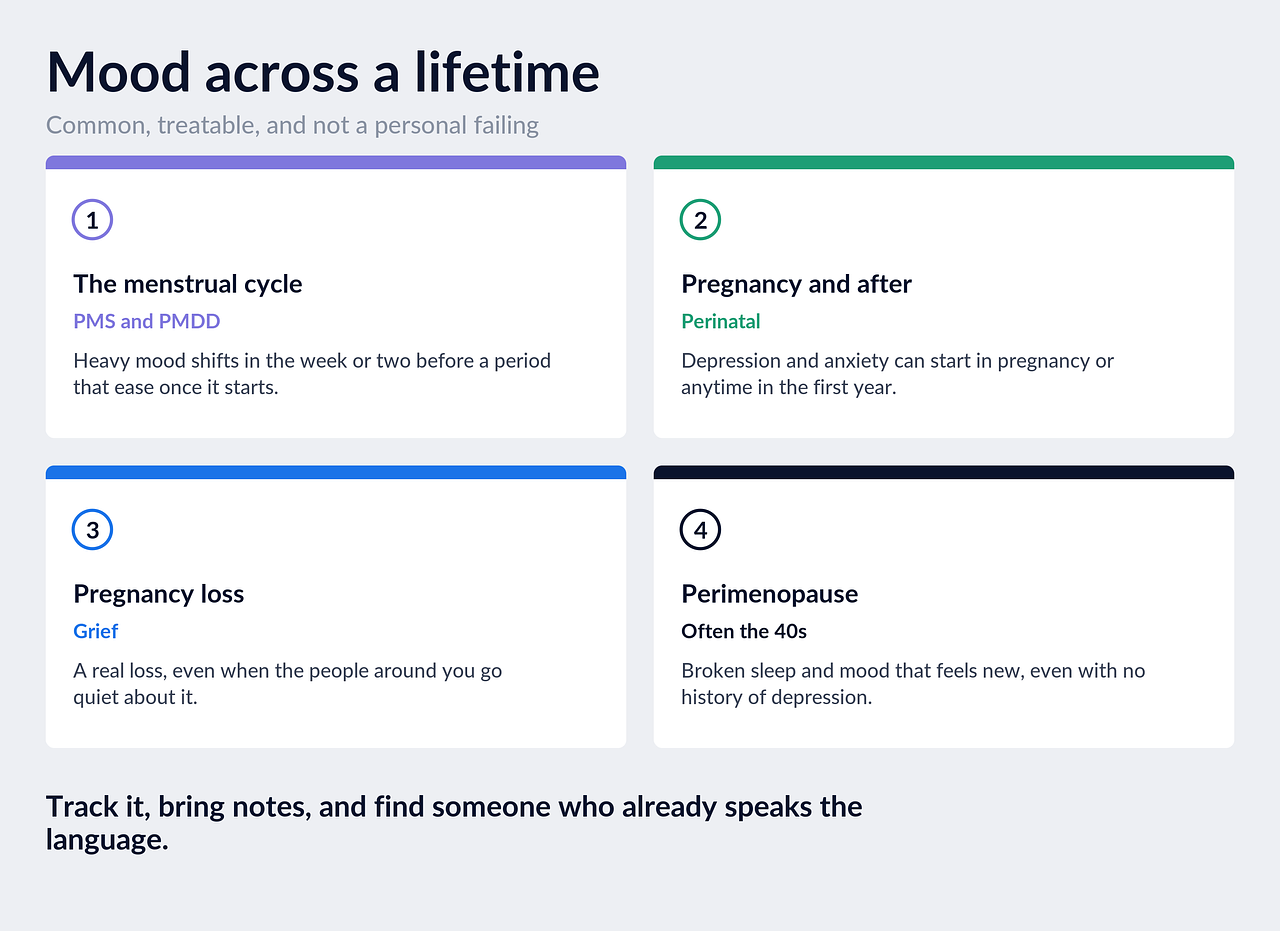
The week before your period isn't supposed to feel like this
Most people notice some mood change before a period. Premenstrual dysphoric disorder, PMDD, is something heavier: depression, rage, anxiety, or a sense of hopelessness that arrives in the week or two before a period and lifts within a few days of it starting. It can strain relationships and work in a way that feels completely out of proportion to the calendar. The International Association for Premenstrual Disorders puts it at about 5.5 percent of women and people assigned female at birth of reproductive age.
The most useful thing you can do before an appointment is track it. A simple daily note of mood and where you are in your cycle, kept for two cycles, is what clinicians use to tell PMDD apart from depression that just happens to flare. Therapy helps with the part you can work on, like the thoughts that show up on day 24 and feel like the truth. A prescriber can walk through medical options, including some that are taken only in the second half of the cycle.
Perimenopause can come with mood changes nobody mentioned
Perimenopause is the stretch of years before periods stop, often starting in the 40s. Sleep breaks up, hot flashes and night sweats show up, and for some people, so does low mood or anxiety that feels new. The 2018 perimenopausal depression guidelines from The Menopause Society and the National Network of Depression Centers found the risk of depression rises during this transition, including for women who've never been depressed before.
The same guidelines name antidepressants and psychotherapy, especially cognitive behavioral therapy, as first-line treatment, with hormone therapy as an option for some people when mood tracks closely with hot flashes and night sweats. In practice, that often means a therapist and a prescriber working the same problem from two sides. If depression is the bigger part of the story, our depression page goes deeper.
Pregnancy, loss, and the year after
Depression and anxiety can start during pregnancy or any time in the year after, and they respond well to help. Our postpartum page covers that stretch in detail, including the intrusive thoughts most new parents have and almost nobody talks about.
Pregnancy loss deserves its own sentence. A miscarriage, a stillbirth, or a termination for medical reasons is a real loss, even when the people around you go quiet about it. On saymore, members asked for that conversation so often that it became an event in New York, then a filmed panel of women from New York and Canada, two of them therapists who'd had miscarriages themselves. By the end, strangers were swapping baby pictures. The conversation continues in the Women's Health and Miscarriages community.
The load nobody sees
And then there's the mental load: being the one who knows when the dog's medication runs out and which parent needs a ride on Thursday. It's caring for kids and aging parents in the same week, which the perimenopause guidelines note can add to the risk. It often looks like competence from the outside and feels like drowning on the inside.
Therapy here is practical. A cognitive behavioral therapist might help you catch a thought like "if I don't remember it, nobody will, and that means I'm failing" and check it against the record ("I forgot one form this month and remembered two hundred other things"). Other sessions are about the harder conversation at home, the one where the load gets redistributed instead of just managed better.
What if I've been brushed off before?
Then bring notes. A two-cycle mood log and a short list of what you've already tried make it much harder for anyone to wave you off, and they give a therapist somewhere to start. You're also allowed to interview a therapist before you commit. A few fair questions for a first call:
- How much of your practice is women's mental health, and which parts: PMDD, perinatal, perimenopause, loss?
- Do you work alongside prescribers or OB/GYNs when hormones are part of the picture?
- How do you tell the difference between a hormone-related mood change and depression that needs its own care?
- What does a typical first month with you look like?
A good therapist will be glad you asked. A vague or dismissive answer tells you something too.
Where The Match fits
Searching for someone who gets this, while you're already running on empty, is a lot. The Match skips it. One intake, answered whenever you have ten minutes. Lived experience and background are part of what the match accounts for, along with approach, identity, and insurance or budget fit, and you see why each therapist came up. Then nothing happens until you decide it does. Nobody contacts you first. No therapist even sees your name unless you reach out.
Not ready for therapy? That's allowed.
saymore is a community first. AskWomen and Women's Health and Miscarriages are open now, and you can post or comment anonymously. Some of the therapists on saymore also run support groups, virtual or in person, which can be a lower-commitment place to start.
A note on this page