Looking for an alternative to BetterHelp? Here's how saymore is different.
For California adults, saymore offers The Match: a free service that takes one intake about what you need and matches you with a California therapist you then see directly, in person or online, rather than a subscription platform that sits between you and your care. BetterHelp earned its name recognition by making online therapy widely available, and for plenty of people it works. This page is for the people it didn't quite fit.
Two genuinely different models
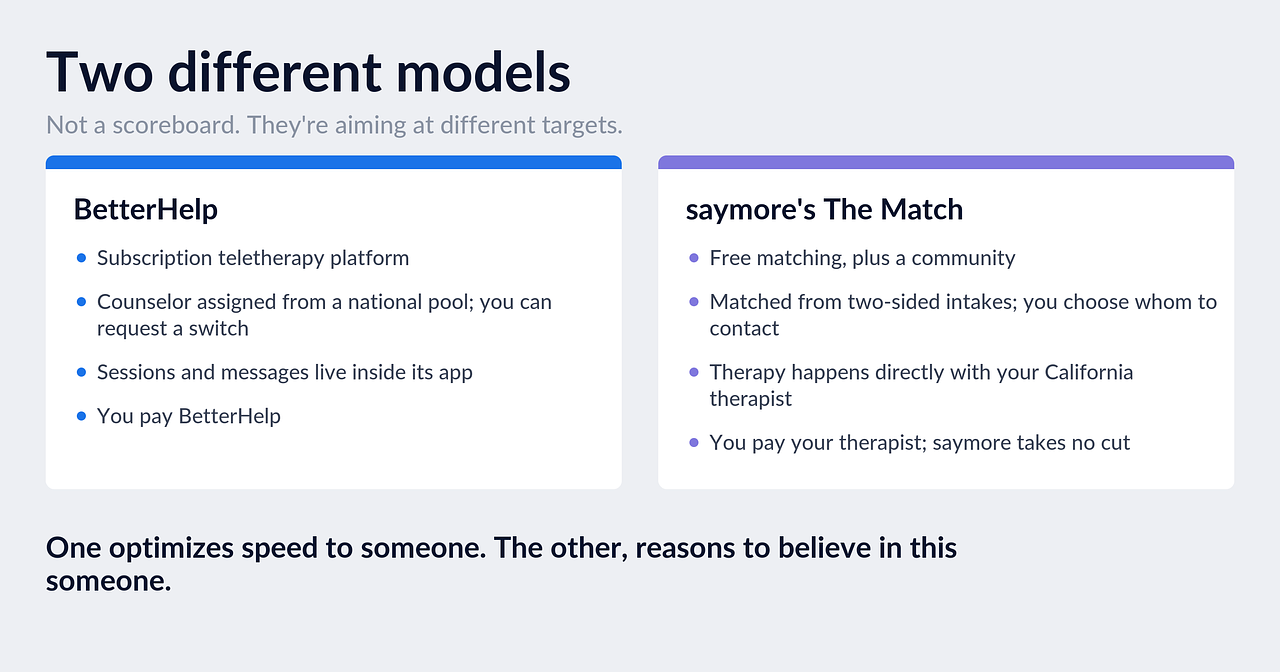
BetterHelp is a therapy platform. You subscribe, you're assigned a counselor from a large national pool (with the option to switch), and your sessions and messages live inside its app. The therapy itself is the product, and BetterHelp is your ongoing counterparty: convenient, fast to start, and structured around its subscription.
saymore is a matching service and a community, and deliberately not a middleman. The Match finds you a California therapist using two intakes: yours, about what you're carrying, how you communicate, and what you can spend, and the therapist's, about how they work and who they work best with. You see your matches and the reasons behind them, reach out to whoever you choose, and from there the relationship is yours. Sessions happen wherever you two decide, at the therapist's own rate, which you saw before ever saying hello. saymore never takes a cut of your sessions.
Side by side
| BetterHelp | saymore's The Match | |
|---|---|---|
| What it is | Subscription teletherapy platform | Free matching to an independent California therapist, plus a community |
| How you get a therapist | Assigned from a national pool; you can request a switch | Matched from two-sided intakes; you choose whether and whom to contact |
| Where therapy happens | Inside the BetterHelp platform | Directly with your therapist |
| Who you pay | BetterHelp, by subscription | Your therapist directly; matching costs you nothing |
| Geographic focus | National | California only |
| In-person option | No, online only | In person or virtual, depending on the therapist |
| Not ready for therapy | Not really its use case | Community and therapist-led support groups, anonymous if you want |
Where BetterHelp is strong, it's genuinely strong: speed, availability, and a format some people prefer. If you're outside California, or you specifically want everything handled inside one app, it may be the better tool. This table describes how the two models are built, not a scoreboard.
Why the differences matter for fit
Research on why therapy works keeps pointing to the relationship between you and your specific therapist. A model built on assignment from a national pool optimizes for speed to someone. A model built on two-sided intake optimizes for reasons to believe in this particular someone. Neither guarantees anything; no one can promise outcomes. But they're aiming at different targets, and it helps to know which target matters more to you right now.
There's also the question of what happens around therapy. BetterHelp begins and ends with sessions. saymore assumes people spend real time in the maybe-stage, so the community, the anonymous conversations, and the therapist-led support groups are the point in themselves, not a path to something else. They're valid places to stay. People treat them that way, too: last year, the community grew by more than 20 percent; over two-thirds of new members came organically or through a friend; and engagement rose by more than 80 percent.
The other names you'll hear
Alma and Grow Therapy help you find in-network therapists and are worth a look when insurance is your first constraint. Psychology Today offers the largest open directory if you'd rather browse everything yourself. Mental Health Match offers quiz-based matching nationally. The matching vs directory comparison breaks down that whole landscape in plain terms.
A note on this page