You don't have to tell the whole story to start.

A car backfires down the street and your body is three steps ahead of you, heart pounding, shoulders up around your ears, before your brain has even named the sound. Then you spend the rest of the afternoon coming back down, reading the same email four times. Or maybe it's quieter than that. You're fine, mostly, as long as you don't take that one freeway exit, or sit with your back to the door, or let anyone get close enough to matter.
Here's what makes trauma extra hard to get help for: the first step usually means explaining yourself to a stranger, and explaining is the exact thing you've been working so hard to avoid. This is where we come in. saymore created The Match, an online tool where we do the heavy lifting for you. One intake about what you're carrying, how you communicate, and what you can spend, and we match you with a California therapist who also answered questions about themselves, how they work, and how they can help. It's free for you, always. And if therapy feels like too big a first step, you don't have to start there.
Big moments and slow ones
Some trauma has a date attached. A crash. A fire that took the house. A sudden death, a deployment, a night in the ER, a moment of violence that split life into before and after. People sometimes call this big-T trauma, and it's what most of us picture when we hear the word.
Other trauma doesn't have a date. It has years. Growing up in a house where you learned to read the room before you learned to read. Being the kid who had to be the grown-up. A relationship that wore you down a little at a time until bracing felt normal. Years of being treated as less than because of who you are. Clinicians often call this complex or relational trauma, and the World Health Organization's diagnostic manual now lists complex PTSD as its own diagnosis.
There's no leaderboard here. One kind doesn't outrank the other, and you don't have to prove your story was bad enough to deserve help. Plenty of people carrying the slow kind spend years telling themselves other people had it worse. Other people having it worse has never once calmed anyone's nervous system down.
How it shows up on a regular Tuesday
Trauma rarely introduces itself as trauma. It looks like jumping at a dropped pan, then snapping at whoever dropped it. Clocking the exits in every restaurant. Feeling strangely flat at a wedding everyone else is crying at, or at your own good news. Rearranging a whole week to avoid one street, one smell, one kind of conversation. Sleeping badly, or sleeping fine and waking up wrung out from dreams you'd rather not describe.
The body tends to keep its own record, too. Shoulders that live somewhere near your ears. A stomach that drops when someone raises their voice, even happily. A sore jaw in the morning, headaches that come out of nowhere, a low hum of being braced for impact all day long. None of that means you're broken. It means your system learned something once and nobody has told it that it can stand down. (It's very committed. That's the problem.)
If some of that sounds familiar, you're far from the only one. About 5 in every 100 adults in the US have PTSD in a given year. Most people who live through something terrible don't develop PTSD, and you don't need to meet the full definition for any of this to be worth talking about.
How do I know if it's really... trauma?
There's no bar to clear, and nobody checks credentials at the door. Some signals worth trusting, though: it's been more than a month and the reactions haven't eased. Reminders hit harder than it seems like they should. Your world has gotten smaller so you can steer around them. You feel numb, or on guard, more often than you feel like yourself. And if you keep telling yourself it wasn't that bad... notice how much effort it's taking to keep believing that.
You don't have to tell the whole story in session one
A lot of people put off trauma therapy because they picture the first appointment as a deposition. Sit down, start at the beginning, leave nothing out. Good trauma work rarely goes that way.
Most trauma therapists start with the present. How you're sleeping. What a hard day looks like. What helps, even a little. Early sessions often build skills for coming back down when your body sounds the alarm, like slowing your breath or naming five things you can see in the room, so that when harder conversations come, you have somewhere to land. Some people take weeks to get there. Some never go through every detail of what happened, and still make real progress.
You set the pace. You can say “I'm not ready to talk about that,” and a good therapist will hear it as useful information, not as you being difficult. You can ask what the plan is and why. If a therapist pushes for details before there's any trust between you, it's fair to say so, and it's fair to find someone else.
Related: switching therapists, what to look for in a first session.
What trauma therapy actually looks like
Trauma responses are your protective system remembering a lesson a little too well. Something dangerous happened, your body wrote a rule to keep it from happening again, and now the rule fires at fireworks, at raised voices, at closeness. Therapy is less about ripping the rule out and more about updating it with what's true now.
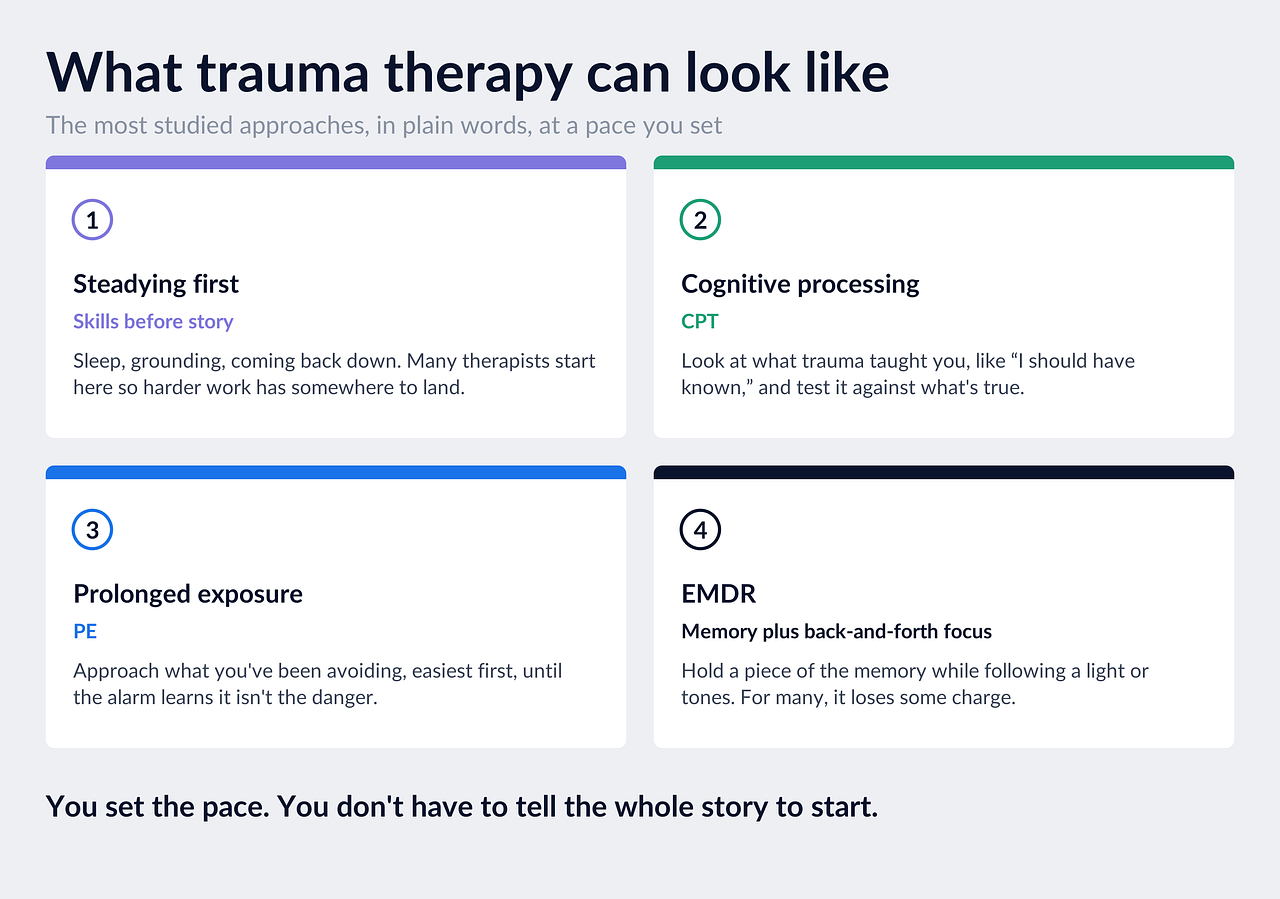
The most studied approaches are trauma-focused, meaning they work with the memory and what it came to mean, at a pace you and your therapist agree on. A few you'll likely hear about:
Cognitive processing therapy, CPT, looks at the conclusions trauma left behind. You'd spot what therapists call stuck points, like “I should have seen it coming,” and examine them together until something truer has room, like “I couldn't have known then what I know now.” Shame tends to loosen once its logic gets looked at in daylight.
Prolonged exposure, PE, works on avoidance. With your therapist, you'd list the things you've been steering around, from the grocery store at rush hour to the memory itself, and approach them gradually, easiest first. Over time, the alarm learns those things aren't the danger. CPT and PE both sit under the umbrella of trauma-focused cognitive behavioral therapy, and a structured version called TF-CBT is built for kids and teens, with a parent or caregiver involved.
EMDR, eye movement desensitization and reprocessing, has you hold a piece of the memory in mind while following a back-and-forth movement or sound, like a moving light or alternating tones. For many people, the memory stays but loses some of its charge.
Somatic approaches start from the body: noticing where the tension sits, practicing grounding, letting your nervous system settle before the story comes in. Plenty of people find them helpful, often alongside the approaches above, though the research on them is still early compared with CPT, PE, and EMDR.
Most of these trauma-focused therapies run about three months, though timelines vary, and some people also add medication through a psychiatrist. What helps depends on you, which is the real reason matching matters.
The first sessions are mostly introductions. Therapists on our platform will tell you people often apologize for “not having real trauma” in the same breath as describing years of bracing. You don't have to make the case. Feeling stuck is reason enough.
The search is the worst part
Finding a trauma therapist the usual way means auditioning strangers before you've decided to trust anyone. Every bio says trauma-informed. Every intro call asks you to explain why you're calling without really explaining why you're calling. Then you do it again with the next one.
The Match skips most of that. One intake about what you're looking for in a therapist, including the kind of approach that appeals to you and what matters to you in who you see, shared as much or as little as you want. We match you with California therapists who fit, including therapists who focus on trauma, and you see why you were matched. Then nothing happens until you decide it does. No therapist even sees your name unless you reach out. When trust is the hard part, being in charge of the next step matters.
Related: how The Match works.
Not ready for therapy? That's allowed.
saymore is a community first. You can read along, post, or comment anonymously, which makes a real difference when the subject is hard to put your name on. Some of the therapists on saymore also run support groups, virtual or in person, which can be a lower-commitment place to start: professional support without the weekly one-on-one. People move between all of these at their own speed. Some end up in therapy. Some stay in the community for good. Both count.
Trauma often travels with company, and these pages go deeper on the ones that show up most.
Related: the anxiety page, the depression page, the grief page.
A note on this page