Why people quit therapy (and why it's usually fit, not you)

Nobody announces they're quitting therapy. You just... reschedule. Then you reschedule the reschedule. Then it's been six weeks, the app is still on your phone, and every time you see the icon you feel a little flicker of guilt, like a gym membership with feelings.
If you've done this once, welcome. If you've done it three times and concluded that you're somehow bad at being helped, this page is for you, because the evidence says something kinder is going on.
Quitting is the norm, not the exception
Depending on which study you read, somewhere between one in five and one in two people stop therapy earlier than planned. However you slice it, that's an enormous number of people, and they are not all broken. The quiet part: therapists know these numbers. Dropout is one of the most studied problems in the field, precisely because the field knows the problem usually isn't the client.

There was a time I was quitting my old therapist and wanting a new one. I had been with my old therapist for years, and she had seen me through so much, including being pivotal in helping me come out as queer. That is something I will always be grateful for. But I was struggling a lot with anxiety, and there were too many sessions that left me feeling worse afterward. This type of anxiety was new for me. I wanted to try someone else. That part was scary. When I tried a new therapist, I remember after the first two sessions throwing my hands up in the air, thinking she had not said much. In the third session, something changed, and I could tell she was seeing me. All the crying I was doing before turned into deep introspection, which she was helping me through. I have now been with her for two years and am grateful I stuck with her. I can be simultaneously so grateful for what my old therapist taught me and acknowledge that my new therapist is a better fit for where I am at now in my life.
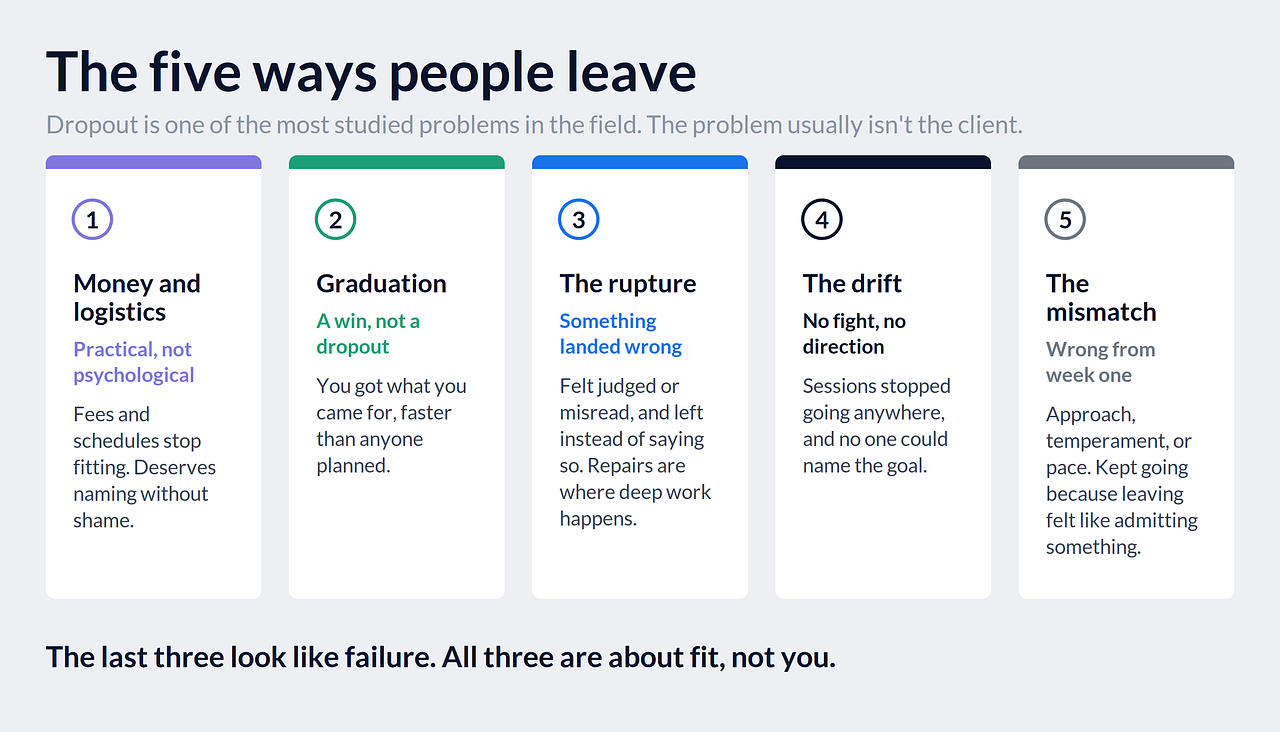
The five ways people actually leave
Money and logistics come first, and they deserve to be named without shame. Sessions are expensive, schedules are hostile, and life reorganizes itself. If that's your story, the fix is practical, not psychological: a therapist whose fee and openings actually fit your life, checked before the first session instead of discovered at the eighth.
Some people leave because they got what they came for, faster than anyone planned. That's a graduation, and it counts as a win.
Then there are the three that look like failure and aren't. The rupture: something landed wrong, you felt judged or misread, and instead of saying so (who would?), you left. Therapists have a whole literature on rupture and repair, and repaired ruptures often produce the best work in the whole arc; unrepaired ones produce quiet exits. The drift: no fight, no rupture, just sessions that stopped going anywhere and a goal nobody could name anymore. And the mismatch that was never right: the approach, the temperament, the pace, wrong from week one, and you kept going anyway because leaving felt like admitting something.
What's usually underneath the last three
When researchers ask why therapy works at all, the strongest ingredient keeps being the working alliance: the felt sense that you and your therapist are on the same project, with the same goals, in a way you both could describe. When that's missing, sessions drift. You perform progress instead of making it. You start editing yourself to be an easier client, which is a lot of work to pay for.
Sometimes it's the approach, not the person. A talk-it-through therapist paired with someone who wants tools, or a worksheets-and-homework therapist paired with someone who needs to be heard first. Both people are doing their jobs. The pairing is the problem, and pairings can be changed.
You're not therapy-resistant
Here's the reframe that therapists on our platform offer their own clients: every therapist who didn't fit taught you something specific about what you need. Too passive, and you learned you want structure. Too quick with the worksheets, and you learned you need room to talk first. Felt judged, and you learned how much the room's temperature matters to you. That so-called failed history is actually a spec sheet, and most people never get to use it, because the traditional search can't read it.
Before you quit: one sentence
If there's any goodwill left, try saying the quiet part in the room: "I don't think this is working, and I'd like to talk about why." Therapists are trained for exactly this. Some of the best stretches of therapy start right after that sentence, and if it goes nowhere, you get to leave with a referral and a clean ending instead of a slow fade. A planned break is allowed too; naming it keeps it from silently becoming an ending.
If the relationship is past that, an email is allowed. You don't owe anyone a breakup session.
Starting again, without the dread
The worst part of quitting is knowing what restarting costs: the tabs, the cold emails, the retelling. That cost is exactly what The Match removes. One intake about what you're carrying, how you communicate, and what you can spend, matched against how California therapists describe their own work, including the things your spec sheet just taught you. You see why you were matched, nobody contacts you first, and it's free for you, always.
See the good-fit guide for how to test the next match properly, and the switching-therapists guide if you're leaving someone now.
A note on this page