You left years ago, and you can still hear it in your head

It's Sunday morning and you're not there. You haven't been in years. And still, when something good happens, a small voice wonders whether you deserve it, and when something goes wrong, you catch yourself checking whether you're being punished. A song in a grocery store can drop you right back into a pew.
If some of that sounds familiar, saymore can help you find someone who gets it. The Match is an online tool where we do the heavy lifting for you: one intake about what you're carrying, how you communicate, and what you can spend, and we match you with a California therapist who also answered questions about themselves, how they work, and how they can help. It's free for you, always.
Religious trauma to me feels like the deeply embedded and unnecessary shame that religion has instilled in me since I was young. When I came out as a queer woman, I lost close friends who were Christian. Now they would say I cut them out of my life… but who wants to be friends with people who love you but believe you are going to hell for who you love? It has taken me years to be “out loud and proud” because of my sexuality whereas my friends who did not grow up in certain religious communities have had a lot more love, acceptance, and frankly, celebration of who they are. And that is how it should be!
What is religious trauma?
Religious trauma is lasting distress tied to religious beliefs, practices, or communities. For some people it comes from fear-based teaching, years of being warned about hell or the end of the world. For others it's shame about their body or sexuality, control by a leader, or being shunned when they asked questions or left. It can come from any tradition, and it can affect people who still believe and practice their faith, as much as people who've walked away.
Psychologist Marlene Winell coined the term religious trauma syndrome to describe what many former members go through. It isn't a formal diagnosis, but what it describes is real. One 2023 sociological study, published in the SHERM Journal, estimated that around a third of US adults have experienced religious trauma, and 10 to 15 percent are living with it now.
How it tends to show up
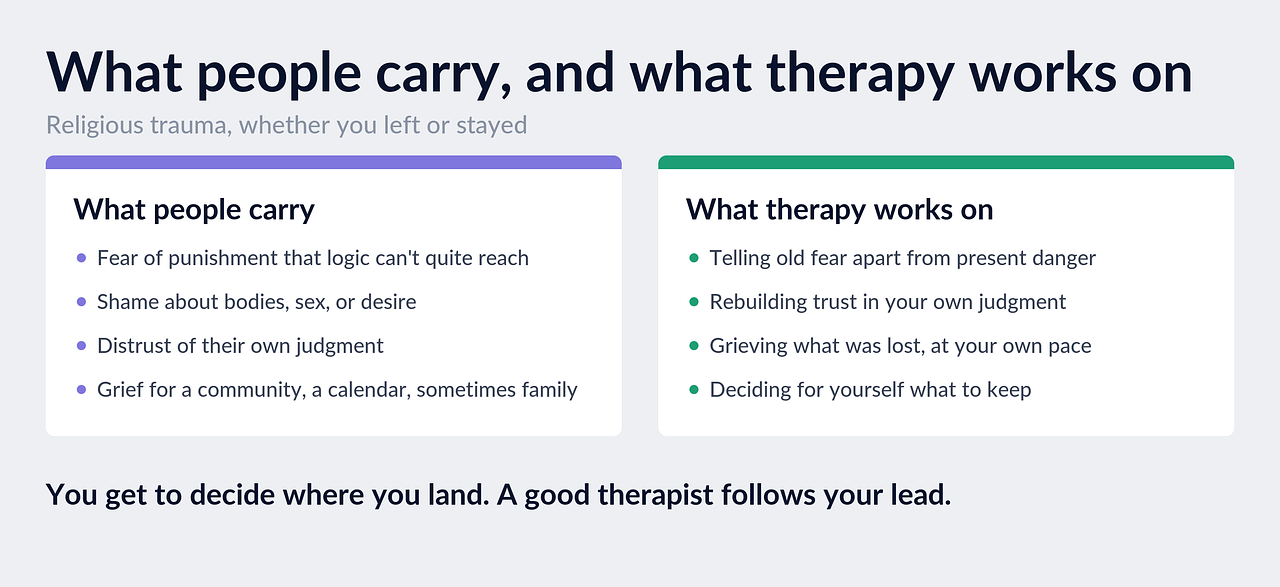
Often it looks like anxiety with a theological edge: a fear of death or punishment that logic can't quite reach. It can look like perfectionism, or a deep distrust of your own judgment after years of being told it was sinful. Shame about sex and bodies can follow people into marriages and relationships long after they've stopped believing what they were taught.
And there's grief. Leaving a faith can mean losing a whole community at once: friends, a calendar, sometimes family. People rarely get a casserole for that kind of loss.
Do I have to leave my faith to heal from it?
No. Some people leave and never look back. Some stay and slowly rebuild a faith that doesn't run on fear. Plenty land somewhere in between and change their minds more than once. A good therapist follows your lead and doesn't steer you toward belief or away from it.
If you'd like a therapist who shares your faith, that's a fair thing to look for. Our guide to faith-based counseling and therapy explains the difference between the two and what to ask.
What does therapy for religious trauma look like?
Much of it is slow, careful talking, with someone who won't flinch when you say the thing you were taught never to say. A cognitive behavioral therapist might help you catch a thought like "something bad will happen because I didn't pray this morning" and check it against the record ("I've skipped thousands of mornings, and the bad days didn't line up with them"). The fear may still flicker, but it gets less say.
For specific memories that still hit hard, like a public shaming or a night of being prayed over, some therapists use trauma-focused approaches such as EMDR, where you briefly hold the memory in mind while following side-to-side eye movements or taps, until it loses some of its charge. Our trauma page explains these approaches in more detail.
Whatever approach they use, a therapist should offer something many people recovering from religious trauma may not have experienced before: a relationship grounded in trust, safety, autonomy, and acceptance.
What about family?
Family is often the hardest part. Holidays, a parent who prays for you out loud, a sibling who's still in. Some moments you long to be close, and others are filled with despair or anger. Therapy can help you work out what you want to say, what you're willing to hear, and where the boundaries go, without needing anyone to agree with you first.
What to ask on a first call
- Have you worked with religious trauma before, and with which traditions?
- How do you approach faith in therapy if I'm still figuring out what I believe?
- Will you respect where I land, whether that's leaving, staying, or neither?
- If something from my religious past comes up as a trauma memory, how do you work with it?
A good therapist will be glad you asked. If an answer sounds like a sermon in either direction, keep looking.
Where The Match fits
Lived experience is part of what the match accounts for, along with approach, identity, and insurance or budget fit. The intake also leaves room to say what didn't work in past therapy, which matters if a past counselor made things worse. You see why each therapist came up. Nobody contacts you first. No therapist even sees your name unless you reach out.
Not ready for therapy? That's allowed.
saymore is a community first, and you can post or comment anonymously, which helps when your family or old congregation might recognize your name. Some of the therapists on saymore also run support groups, virtual or in person, which can be a lower-commitment place to start.
A note on this page