Therapist matching vs directory search: which actually finds you the right therapist?
A directory gives you a searchable list of therapists and leaves the choosing to you; a matching service like saymore's The Match asks you questions first and does the narrowing for you. Both can get you to a good therapist. The difference that matters is who does the work of figuring out fit, and how much of that work you have the energy for right now.
What directories do well
Psychology Today has the largest searchable directory in the country. Zencare curates and vets its profiles. Alma and Grow Therapy organize their networks around insurance, which matters enormously if in-network care is your first constraint. These are real strengths, and if you already know you want, say, an EMDR therapist within your plan who has evening openings, a directory with good filters will serve you well.
The tradeoff is baked in: the directory's job ends where your hardest problem begins. It hands you forty profiles that all match your filters, all warm, all accepting new clients, maybe. Which of them will you actually talk to? The filters can't tell you. That last mile, the fit mile, is yours to walk alone, usually by cold-emailing strangers and trying to read personalities through intro calls.
What a matching service does instead
Matching flips the order. Instead of browsing first and guessing at fit, you describe what you're looking for once, and the service brings you the therapists it has reasons to believe will fit. Mental Health Match does this with a quiz on the client side. BetterHelp does a version of it inside its subscription platform, assigning you a counselor you can swap.
The Match runs the idea further in one specific way: both sides answer questions. You complete an intake about what you're carrying, how you communicate, and what you can spend. Therapists on the platform complete their own, describing how they work, who they work best with, and what they charge. The match runs on both sides of the story, including specialty, approach, identity, insurance and budget fit, and how a therapist actually describes their practice. You see your matches and the reasons behind them, and then nothing happens until you decide it does. No therapist sees your name unless you reach out.
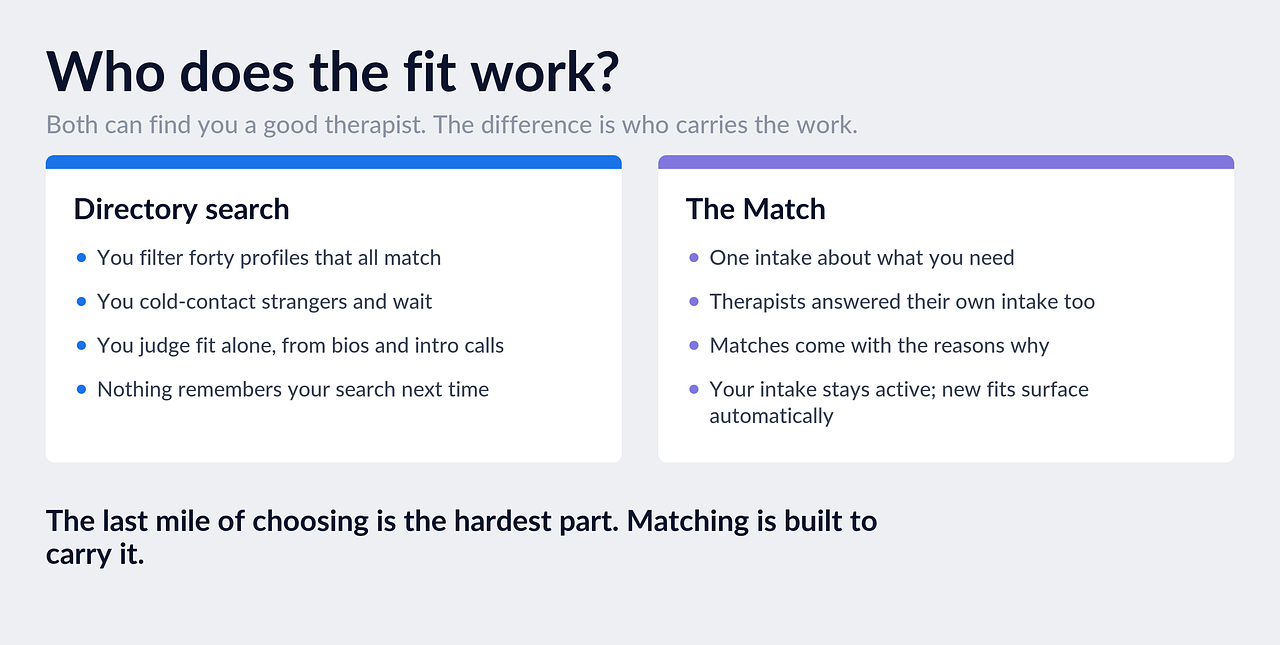
Side by side
| Directory search (Psychology Today, Zencare, Alma) | saymore's The Match | |
|---|---|---|
| How it starts | You browse and filter profiles yourself | One intake about what you need |
| Who does the fit work | You do, profile by profile | The matching does, from both intakes |
| Therapist's side of the story | A self-written bio you interpret | A structured intake about how they work, matched against yours |
| Coverage | National | California only |
| Cost to you | Free to browse; sessions vary | Matching costs you nothing; saymore never takes a cut of sessions |
| First contact | You cold-contact therapists | You see matches and reasons; you reach out only if you want to |
| If nothing fits yet | Search again later | Your intake stays active; new fitting therapists surface automatically |
This table describes how each model is structured, not a claim that one is universally faster or cheaper. Directories are stronger on raw volume and national reach. Matching is stronger when the choosing itself is the barrier.
The question underneath the question
People asking "matching or directory" are usually really asking: how do I stop getting this wrong? The research answer is that fit, the working alliance between you and a specific therapist, predicts whether therapy helps better than credentials or method do. Directories weren't built to measure fit. They were built to organize supply. Matching services exist because somebody noticed the gap between those two jobs.
So the practical rule: if you have the energy and knowledge to evaluate profiles, a directory gives you the most raw choice. If you've tried the list and bounced off it, or the search itself is the thing you can't face, let a matching service carry that part. Either way, test the fit properly once you're in the room.
Where saymore fits, and where it doesn't
The Match is for California adults. If you're outside California, a national service will serve you better today, full stop. If you are here, you get one more thing no directory offers: a place to land that isn't therapy. saymore is a community first, with anonymous conversations and therapist-led support groups, so "not ready yet" is a valid state instead of a dead end. And it isn't an empty room: last year the community grew more than 20 percent, engagement rose more than 80 percent, and over two thirds of new members arrived organically or through a friend, which is exactly how you'd hope a place like this grows.
A note on this page