When your brain won't accept “probably fine”

You locked the door. You know you locked it. You watched your own hand turn the key. And still, somewhere between the porch and the car, the thought shows up: but did you, though? So you walk back and test the handle. Then once more, to be sure. The relief lasts about as long as the drive to work, and tomorrow you'll do it again.
Or it isn't the door. It's a flash of something so out of character it scares you, followed by an hour of making sure it doesn't mean anything. It's the fourth “are you mad at me?” text to someone who already said no. It's an afternoon of searching symptoms, or replaying a conversation word by word, chasing a feeling of certainty that never quite arrives.
This is where we come in. saymore created The Match, an online tool where we do the heavy lifting for you. One intake about what you're carrying, how you like to work, and what you can spend, and we match you with a California therapist who also answered questions about themselves, how they work, and how they can help. For OCD, that last part matters more than usual. It's free for you, always. And if therapy feels like too big a first step, you don't have to start there.
The loop, in slow motion
OCD runs on a loop. An intrusive thought shows up. Most people get them, the strange flashes and what-ifs that pass through any brain, but this one sticks, and it lands with an alarm attached: this is dangerous, and it's on you to fix it. So you do something to make the alarm stop. You check, wash, count, pray, ask, review, or quietly cancel the thought with a better one. That's the compulsion. And it works, for a minute.
The trouble is what that minute teaches. Every time a compulsion brings relief, your brain files the original thought as a real threat that needed handling, so it sends the thought again, louder. The International OCD Foundation compares it to a smoke alarm that goes off every time you burn toast. The compulsions are your attempts to stay safe when the alarm sounds, and they're also what keeps it so sensitive.
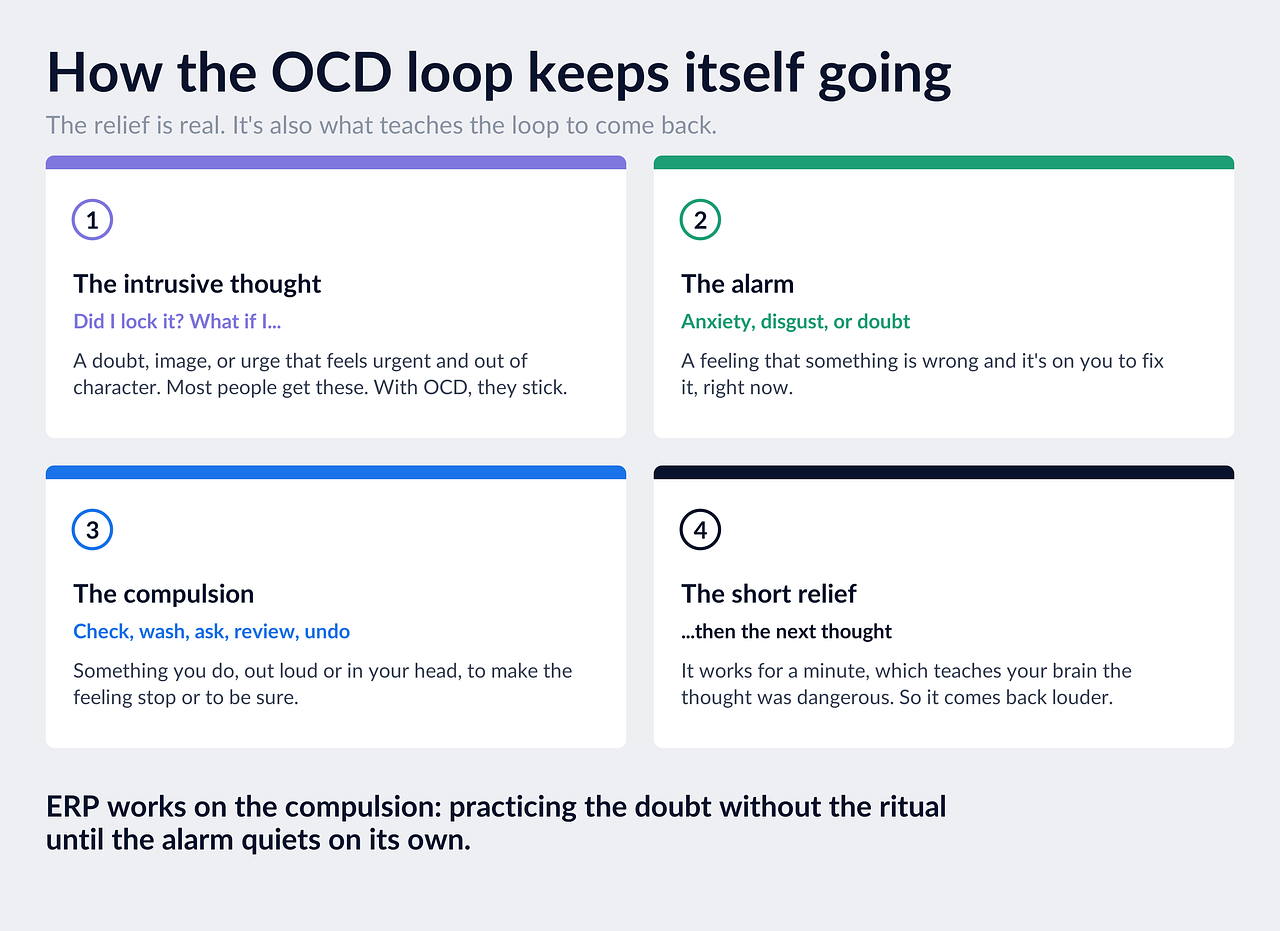
Reassurance seeking is the sneaky one, because it looks like being a normal, caring person. Asking your partner if they're sure they still love you. Confessing a thought to a friend so they can tell you it's fine. Searching until you find the one forum post that settles it, for about ten minutes. The person reassuring you means well. The loop doesn't care.
It shows up in a lot of forms
Most people picture OCD as tidy desks and hand washing, and plenty of people with OCD don't recognize themselves in that picture at all. A few of the forms it takes:
- Checking: locks, stoves, emails you already sent, whether you hit someone on the drive home.
- Contamination: germs, chemicals, illness, or a vague sense of being dirty that soap doesn't fix.
- Harm: unwanted thoughts or images of hurting someone, often someone you love. They're upsetting precisely because they're the opposite of what you want.
- Relationship: a running audit of whether your partner is the right one, or whether you really love them, no matter how good things are.
- Scrupulosity: fear of having done something morally or religiously wrong, with an urge to confess, pray, or make it right.
- “Pure O”: a nickname for OCD where the compulsions mostly happen in your head, like mental reviewing, counting, or swapping a bad thought for a good one. The name is a little misleading. The compulsions are there. They're just quiet.
The content of the thoughts isn't a confession. OCD tends to go after whatever you care about most, which is exactly why the thoughts feel so loud. You don't need to know which form you're dealing with before you reach out. Sorting that out is part of the work.
Related: the anxiety page for readers whose worry doesn't come with rituals.
How do I know if it's really… OCD?
Everyone double-checks the stove sometimes, and plenty of people call themselves “so OCD” about their spice rack. The difference is what it costs. Clinicians look at whether the thoughts and rituals eat up a lot of time (more than an hour a day is the usual marker), cause real distress, or get in the way of the things you value. A few other signals worth trusting: part of you knows the fear doesn't quite add up, and you feel driven to act on it anyway. You've started avoiding places, people, or objects to keep the thoughts away. The certainty you're chasing never sticks. And if you've read this section three times to make sure you “really” qualify… that might be part of the pattern too.
You'd be in good company. About one in 40 adults deals with OCD at some point in their lives, and on average it takes more than seven years to get an accurate diagnosis, largely because so few people recognize what it actually looks like.
What therapy actually looks like: ERP
The most studied treatment for OCD is exposure and response prevention, ERP, a specific kind of cognitive behavioral therapy. It sounds intimidating on paper. In practice it's a plan you build with your therapist, at a pace you both agree to.
Exposure means deliberately getting close to the thing that sets off the alarm. Response prevention means not doing the compulsion afterward. Take the door. You and your therapist might start with locking it once, walking to the car, and driving away without going back. The anxiety climbs. Your brain insists that this time is different. You let it insist, and you don't check. Then you notice the wave crest and start to come down on its own, which is the one thing the compulsion never let you find out. Over the following weeks you work up a ladder: leaving without a photo of the lock, leaving for the whole day, eventually leaving without giving it much thought.
Reassurance gets the same treatment. Instead of asking your partner “are you sure?”, you practice answering the doubt with “maybe, maybe not” and getting on with your evening. It's uncomfortable. That's sort of the point, and a good ERP therapist won't push faster than you've agreed to.
For some people, ERP is the whole plan. Others add something alongside it, or try something different when ERP doesn't take. The International OCD Foundation lists acceptance and commitment therapy (ACT), which works on changing your relationship with the thoughts instead of arguing with them, and inference-based CBT (I-CBT), which looks at the reasoning that makes an obsessional doubt feel believable, among the options when first-line care isn't enough. Medication helps many people too. SSRIs are the usual first choice for OCD, often at higher doses than for depression, and they're prescribed through a psychiatrist or another prescriber, since therapists on saymore don't prescribe. A good therapist will talk about medication plainly, without pushing it or dismissing it.
Why fit matters more here than almost anywhere
This is the uncomfortable part. Plenty of kind, skilled therapists aren't trained to treat OCD, and general talk therapy on its own can feed it without anyone meaning to. If you spend each session explaining your fear and your therapist answers “you'd never do that, you're a good person,” that's reassurance, and the loop eats it. The International OCD Foundation notes there's no research evidence that traditional insight-focused talk therapy works for OCD on its own, and recommends trying ERP or medication first. Talk therapy can still help later, with everything else life is throwing at you.
So it's worth asking directly on a first call. You're allowed to interview a therapist, and these are fair questions:
- How much of your practice is OCD?
- Do you use exposure and response prevention, and where did you train in it?
- What might ERP look like for the kind of thoughts I have?
- What do you do when I ask you for reassurance?
A therapist who treats OCD will have specific answers. If the answers stay general, keep looking.
Related: what to expect in a first session, the good-fit guide.
Where The Match fits
OCD and a therapist search are a rough combination. Twelve tabs, a nagging doubt about whether each one is the right one, whether you'll pick wrong, whether you should check one more… you can see where this goes.
The Match takes the comparing off your plate. In your intake you can name OCD and the kind of help you're looking for, including ERP, and California therapists on the platform describe their specialties and how they work. You see your matches and why each one came up. Nobody contacts you first. No therapist sees your name unless you reach out, and you can still ask every question above on that first call.
Two more places worth knowing about: the International OCD Foundation's Resource Directory lists therapists who specialize in OCD, along with support groups, and its California affiliates, OCD SoCal and OCD SF Bay Area, run local events and groups.
Related: how The Match works, IOCDF Resource Directory, OCD SoCal, OCD SF Bay Area.
Not ready for therapy? That's allowed.
saymore is a community first. People talk about intrusive thoughts there, and you can post and comment anonymously, which matters when the thoughts are the kind you've never said out loud. Some of the therapists on saymore also run support groups, virtual or in person, which can be a lower-commitment place to start: professional support without the weekly one-on-one. People drift between all of these at their own speed.
One gentle caution if you're dealing with OCD: a community can turn into one more place to seek reassurance. Reading that other people have the same thoughts helps. Asking strangers to confirm you're fine, over and over, is the loop in a new outfit.
From the saymore blog
Our founder on why showing up for other people is worth the trouble:
Related: The Beautiful Inconvenience of Community.
A note on this page