Online therapy vs in-person therapy in California: which fits you?
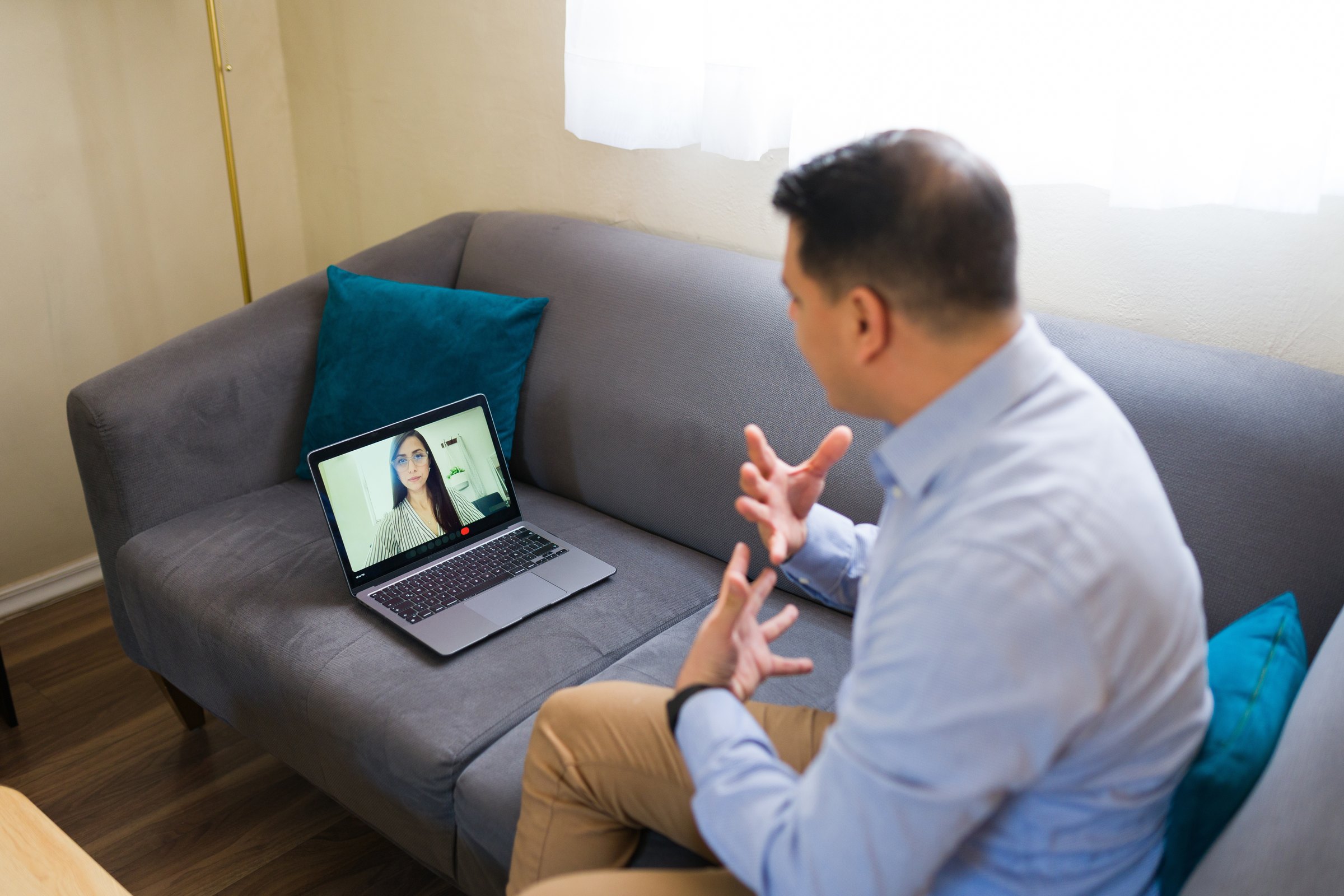
Research finds online therapy works about as well as in-person therapy for most people, so in California the choice comes down to privacy, schedule, and where you open up best, and The Match by saymore lets you say which you'd prefer.
Picture the actual Tuesday. A 6 p.m. appointment across town means leaving work early, sitting on the 405, circling for parking, and walking in already frazzled. A video session means opening your laptop at 5:58 with the bedroom door shut and the dog parked on your feet. Neither one is the serious version of therapy. They're two ways into the same work, and the better one is usually whichever you'll keep showing up for.
There's one part of the decision California makes for you: whoever you see, on a screen or in a room, has to be licensed here. More on that below, because it matters more online than most people expect.
What the research says
Researchers have been comparing the two formats for years, and the pattern holds. A 2021 meta-analysis in Clinical Psychology & Psychotherapy pooled dozens of studies and found therapy by live video did about as well as in-person therapy, with the strongest results for anxiety, depression, and PTSD. A second 2021 review, in Clinical Psychology Review, covered 57 studies and more than 4,300 clients and found video therapy produced results largely equivalent to sessions in the room.
Two caveats are worth knowing. Averages describe groups, not you, and the researchers themselves point out there are fewer large randomized trials than they'd like. And what predicts progress more reliably than format is the relationship. A 2018 meta-analysis of 295 studies found the bond between client and therapist predicted outcomes about equally in face-to-face and internet-based therapy. So the format question is real. It's just smaller than the who question.
Related: the good-fit guide.
The California rule that matters most online
A therapist has to hold a California license to treat you while you're physically in California, whether the session happens on video or in an office. That's the position of both the Board of Behavioral Sciences, which licenses marriage and family therapists, clinical social workers, and professional clinical counselors, and the Board of Psychology. California also isn't part of PSYPACT, the compact that lets psychologists in member states practice telehealth across state lines.
That cuts both ways. The upside: any California-licensed therapist can see you by video anywhere in the state, so someone in Redding isn't limited to the clinicians within driving distance, and a specialist in Los Angeles can be a real option for someone in Fresno. The fine print: board rules require your therapist to ask where you are at the start of each video session and note it, so don't be surprised when that comes up every week.
If you'll be out of state for a few weeks, ask before you go. Whether your therapist can see you there depends on that state's rules too. And if you've just moved here, your out-of-state therapist may be able to keep seeing you for a short stretch: both boards now allow out-of-state licensees a single 30-day window per calendar year, with registration or approval first. After that, you'll need someone licensed in California.
Related: how to check anyone's license.
On cost, California law helps here too. Since 2021, state-regulated health plans have had to cover therapy by telehealth on the same basis as in person, and they can't charge a higher copay or coinsurance for the video version. Some employer plans are self-funded and follow federal rules instead, so ask your plan or HR if you're not sure which kind you have.
Related: the California insurance guide.
Privacy at home is the part nobody plans for
In an office, privacy comes with the room: a closed door, a sound machine humming in the hallway, a therapist whose job includes keeping it that way. At home, you're the one building it, and thin walls, roommates, kids, and a partner who wanders into the kitchen at the wrong moment all count. Your therapist is expected to use secure, private technology on their end. Your end is up to you.
- Headphones help more than people think. They keep the other half of the conversation in the room with you.
- A fan or white noise machine outside the door covers more than you'd expect.
- A parked car is a perfectly respectable therapy office, and a common one.
- Tell your therapist at the start if someone else is home, and agree on what you'll do if someone walks in.
If there's nowhere at home you can talk freely, or the person you most need to talk about lives with you, that's a good reason to choose an office. Full stop.
The commute and the couch
The drive to an appointment does something quietly useful. It gives you twenty minutes to figure out what you want to say, and twenty minutes afterward to let it settle before you're back in regular life. Online, you can close the laptop and be standing at the stove thirty seconds after crying about your dad, which is efficient and also a lot.
If you go online, build your own buffer: a few minutes before to get quiet, a few after to walk around the block or sit in the car. Nobody needs to see your pajama pants, and nobody will. It still helps to treat the hour like an appointment rather than a call you squeeze between two others.
The couch has its own upside. Some people talk more freely from their own space, with their own blanket and their own mug, than they ever would in a stranger's office. If that's you, it's a real point in online's favor.
Who tends to prefer which
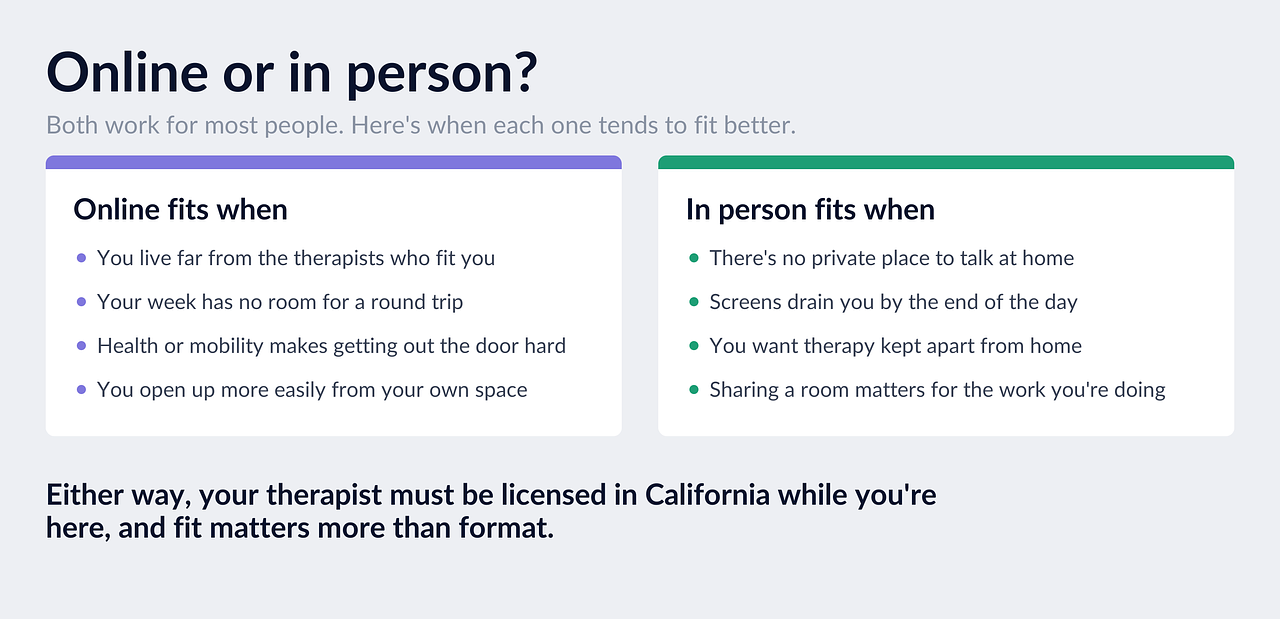
There's no rule here, just patterns that come up a lot. Online often suits people who:
- live far from the therapists who fit them, which in a state this big is a lot of people
- have packed schedules, small kids, or caregiving that makes a round trip hard to protect
- live with a chronic illness, a disability, or anything else that makes getting out the door its own project
- find it easier to open up from their own space
In person often suits people who:
- don't have a private place to talk at home
- are drained by screens after a full day of them
- want therapy to happen somewhere separate from the rest of their life
- are doing work where sharing a room helps, which some couples, family, and child therapists prefer
Online, in person, or hybrid, side by side
| Online | In person | Hybrid | |
|---|---|---|---|
| Cost | Session fees are usually the same. No gas, parking, or extra childcare. State-regulated plans can't charge more cost-sharing for telehealth. | Same session fee, plus the time and cost of getting there. | Same session fee, with travel costs only on in-person weeks. |
| Convenience | Any California-licensed therapist, anywhere in the state. Easier to keep on busy weeks. | Limited to therapists you can reach. A fixed place and time that some people find grounding. | Room to adjust when life shifts, like a move, a new job, or a newborn. |
| Privacy | Depends on your home. Headphones, a closed door, or a parked car help. | Built into the room. | The office for heavier sessions, video for the rest, if that suits you. |
| Best for | Busy schedules, long distances, health or mobility limits, people who open up at home. | No private space at home, screen fatigue, wanting therapy kept apart from home. | People who want both, or want to start in person and switch later. |
| The California rule | Your therapist must be licensed in California while you're here. | Same. | Same. |
Hybrid: you don't have to pick forever
Plenty of California therapists see clients both ways, and a lot of people mix them. Some start in person to get a feel for the therapist, then move to video once the relationship feels solid. Others go online for a busy season and come back to the office when the week has room again. If flexibility matters to you, ask on the first call whether the therapist offers both and how switching works.
Related: what to look for in a first session.
Where The Match fits
The Match matches people in California with California therapists, so the licensing question is settled before you see a single name. In your intake, you tell us what you're carrying and how you like to work, including whether you'd rather meet online, in person, or either way, and that sits alongside specialty, approach, identity, and insurance and budget fit. California therapists on the platform answer their own intake about how they work. You see who fits and why. Nobody contacts you first, and it's free for you.
If weekly therapy feels like a lot to commit to in any format, some of the therapists on saymore also run support groups, virtual or in person, which can be a lower-commitment place to start. And the saymore community is open, with anonymous posting and commenting, for whenever you're not ready to say it out loud.
Related: how The Match works.
A note on this page