If food takes up more of your day than you'd tell anyone

You already know what's in the fridge, and you've already decided what you're allowed to have from it. Maybe you said you'd eaten when you hadn't, or you ate standing at the counter so nobody would see. Most of the day runs on rules you didn't exactly choose, and breaking one costs you the rest of the afternoon.
If some of that sounds familiar, you don't have to sort it out alone, and saymore can help you find someone who knows this territory. The Match is an online tool where we do the heavy lifting for you: one intake about what you're carrying, how you communicate, and what you can spend, and we match you with a California therapist who has also answered questions about themselves, how they work, and how they can help. The best part? It's free for you, always.
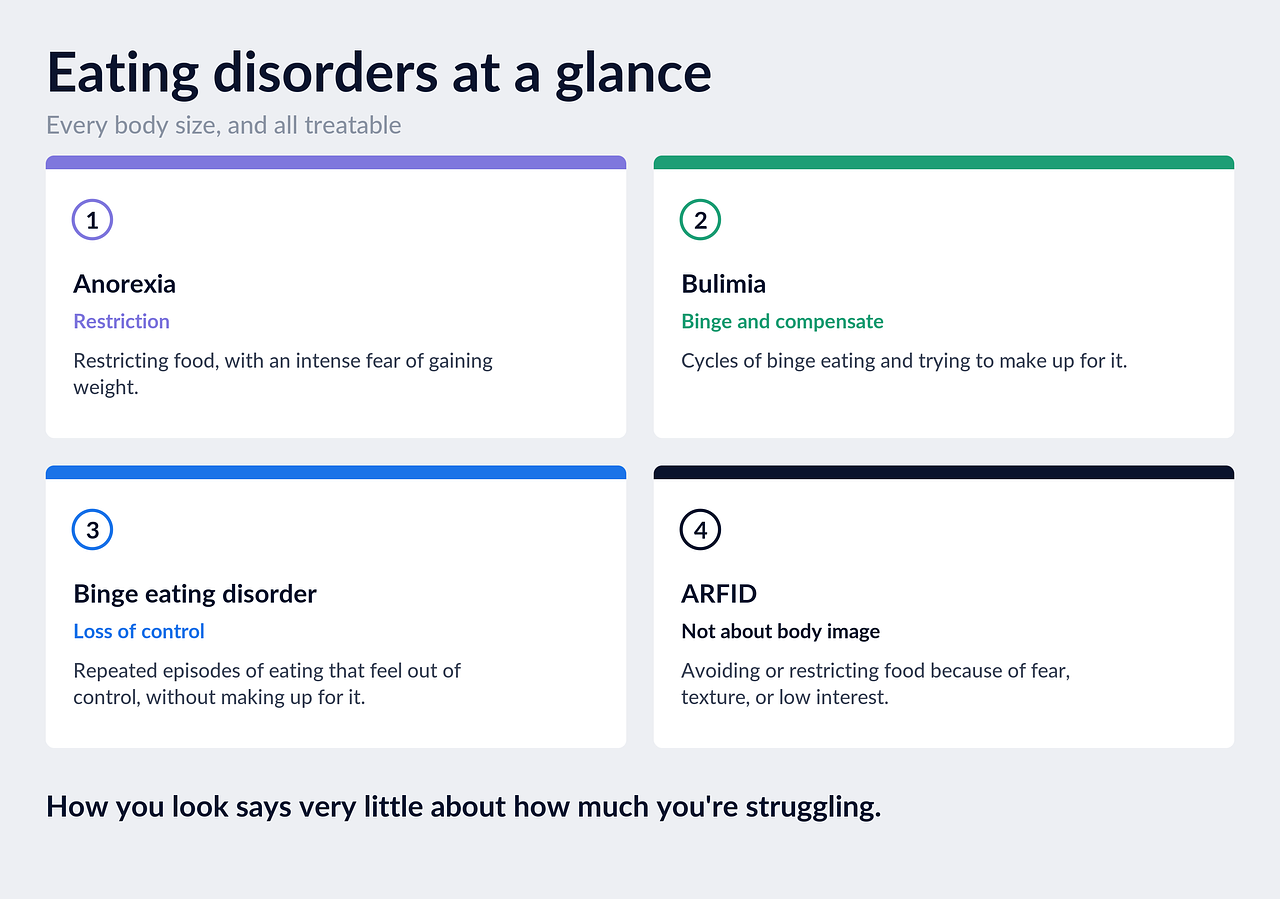
You don't have to look sick to be struggling
The picture most people carry of an eating disorder is narrow, and it keeps a lot of people from getting help. Fewer than 6 percent of people with eating disorders are medically underweight. Historically, this has been part of the main criteria for "needing help" - excluding a majority of those struggling from access to resources. Eating disorders show up in every body size, every gender, every age, and every background. Harvard's STRIPED research program estimates nearly 30 million people in the US will be diagnosed with one in their lifetime.
If you've ever thought "it isn't bad enough to seek help," you're not alone. Your eating disorder is your biggest barrier to seeking help - it thrives on the idea of not being "sick enough" as it takes over your life. You don't have to earn help by getting sicker.
How do I know if it's really... an eating disorder?
You don't need to know before you reach out. A few patterns are worth taking seriously:
- Food, eating, or your body takes up a big share of your thinking most days
- Strict rules about what, when, or how much you can eat, and real distress when one breaks
- Eating in secret, or avoiding meals with other people
- Feeling out of control around food, then guilty or ashamed afterward
- Trying to make up for what you ate
- Anxiety around food, body, and meal times serves as a barrier to fully showing up in other areas of your life that you love
If a few of those landed, it's worth talking to a therapist and a team of experts ready to support you. Eating disorders can affect your heart and other organs even when you feel fine, so a medical check-in belongs in the plan from the start.
What does treatment actually look like?
Ideally, you are supported by a team. At a glance: a therapist will help you work on the thoughts and patterns that keep the eating disorder going. A registered dietitian helps rebuild regular eating without the rules. A doctor keeps track of your physical health. You don't need all three on day one, and a good therapist can help you coordinate together.
For adults, one of the most studied approaches is Cognitive Behavioral Therapy adapted for eating disorders. In practice, you and your therapist map the cycle you're stuck in, then test the rules one at a time. A rule like "if I eat this, I'll lose control" gets checked against what actually happens when you try, with support, in small steps. Some therapists also teach skills from Dialectical Behavior Therapy for riding out urges without acting on them.
For teens, family-based treatment is often the first approach. Parents take on a bigger role around meals for a while, with the therapist coaching the whole family, and then hand control back as things improve.
This is simply a snapshot of a typical course of treatment, but everyone is different and unique. The right therapist will help you navigate your eating disorder with clarity and a holistic view of you as the expert of your own experience.
From a weekly session to more support
Eating disorder care comes in levels. Many people start with weekly outpatient therapy. If that isn't enough, there are intensive outpatient programs, which meet several times a week, and partial hospitalization, which is most of the day on weekdays while you sleep at home. Residential and inpatient care are for when someone needs round-the-clock support or medical stabilization. An assessment helps decide where to start, and people move between levels as they need to.
Does insurance cover it in California?
Often, yes. California's SB 855 requires fully insured health plans issued or renewed on or after January 1, 2021 to cover medically necessary treatment for mental health conditions, including eating disorders, based on generally accepted clinical standards rather than the plan's own rules. It also bars those plans from limiting coverage to short-term or acute care. Coverage details still vary, so it's worth calling your plan and asking what they cover at each level of care.
GLP-1s, and the new pressure to be thin
Weight-loss medications have changed the conversation about bodies fast, and for people with a history with food, that can stir things up. Our page on thinness culture and GLP-1s covers that pressure on its own.
Where The Match fits
Searching for a specialist while you're already exhausted is a lot. The Match does it from one intake, and you can ask for a specific approach or someone with eating disorder experience. The match also accounts for identity and insurance or budget fit, and you see why each therapist came up. Nobody contacts you first. No therapist even sees your name unless you reach out.
Not ready for therapy? That's allowed.
A first conversation can be smaller. The National Alliance for Eating Disorders runs a free helpline answered by licensed therapists who specialize in eating disorders, and they can talk through options and referrals. On saymore, you can post or comment anonymously in the community. Some of the therapists on saymore also run support groups, virtual or in person, which can be a lower-commitment place to start.
A note on this page