What's the difference between a counselor and a therapist?

Sometimes nothing at all. Plenty of licensed counselors are therapists, and most people use the two words interchangeably. The difference that matters is the license. A licensed professional counselor has a graduate degree, supervised training, and a state board behind them, while "counselor" or "therapist" on its own can describe a lot of different people.
Why the words confuse everyone
You'd think the job titles would sort themselves out. They don't. "Therapist" is the umbrella people use for anyone doing talk therapy. "Counselor" is older and even wider: school counselors, career counselors, camp counselors, pastoral counselors. Some are licensed mental health professionals. Many aren't, and aren't meant to be. So when a directory, a church bulletin, or a website says counselor, the useful next question isn't what they're called. It's what they're licensed as.
The licenses behind the words
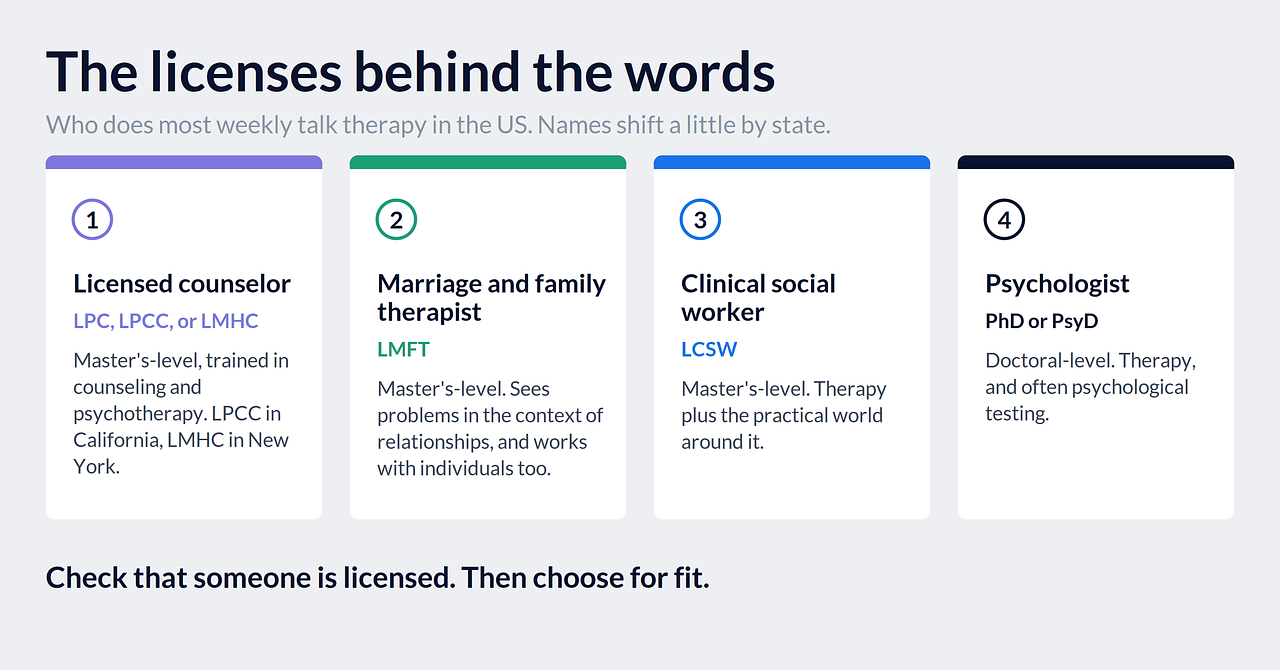
Most weekly talk therapy in the US is done by four kinds of licensed clinicians. The names shift a little by state; the training is broadly similar.
- Licensed professional counselors. Master's-level clinicians trained in counseling and psychotherapy. It's an LPC in Texas and many other states, an LPCC in California, and an LMHC in New York.
- Marriage and family therapists (LMFT). Master's-level, trained to see problems in the context of relationships and families. They work with individuals too.
- Clinical social workers (LCSW). Master's-level, trained in therapy plus the practical world around it, like housing, benefits, and systems of care.
- Psychologists (PhD or PsyD). Doctoral-level. They do therapy and often psychological testing.
Psychiatrists are medical doctors. Most focus on diagnosis and medication, and some do therapy too.
Every one of these licenses means a graduate degree, supervised clinical experience before practicing independently, a licensing exam, continuing education, and a state board that takes complaints. For weekly talking, the license type tells you less about who'll help you than people expect. Whether someone is licensed at all tells you a lot.
Counselors who aren't therapists
Each of these does good work in its own lane.
- School counselors support students with academics, college planning, and short-term personal issues. They usually refer out for ongoing therapy.
- Pastoral and faith-based counselors offer guidance within a religious role. In some states, including Texas, they can counsel without a mental health license.
- Life coaches help with goals and accountability. Coaching isn't a licensed profession, and a good coach will tell you when something needs a therapist.
- Peer counselors and support specialists bring lived experience. Some are certified, and they can be a real lifeline alongside clinical care.
What about associates and interns?
You'll sometimes see titles like Associate Marriage and Family Therapist or Associate Professional Clinical Counselor in California, or LPC Associate in Texas. These are clinicians who've finished their degree and are completing their required hours under a licensed supervisor. They're legitimate, supervised, and often charge less, which makes them a good option when cost is the hurdle.
How to check anyone's license
Every state has a free lookup, and it takes about a minute. In California, the Department of Consumer Affairs license search covers the Board of Behavioral Sciences (LMFTs, LCSWs, LPCCs, and their associates) and the Board of Psychology. In Texas, the Behavioral Health Executive Council's lookup covers counselors, marriage and family therapists, social workers, and psychologists. In New York, it's the Office of the Professions verification search. Looking someone up isn't rude. Therapists look each other up all the time.
So which one do you need?
For most people looking for weekly help with anxiety, depression, a relationship, grief, or the stuff that doesn't have a name yet, the answer is a licensed therapist whose specialty covers what you're carrying and whose style suits how you process things. Whether their license says counselor, marriage and family therapist, or social worker matters less than the fit.
If you're in California, that's what The Match is for. You answer an intake about what you're carrying and how you like to work, California therapists on the platform have answered their own, and you see who fits and why. It's free for you, and nobody contacts you first.
A note on this page