Grief doesn't run on anyone else's schedule.
You pick up your phone to tell her something funny and get halfway through the text before you remember. Or it's the grocery store, and the cereal only he ever bought is sitting on the shelf where it always was, and suddenly you're standing very still in aisle six. Grief has terrible timing. It shows up mid-meeting, at a green light, while folding laundry on an otherwise fine Tuesday.
And at some point, usually sooner than you'd expect, everyone around you goes back to normal while you're still carrying it. This is where we come in. saymore created The Match, an online tool where we do the heavy lifting for you. One intake about what you're carrying, how you communicate, and what you can spend, and we match you with a California therapist who also answered questions about themselves, how they work, and how they can help. It's free for you, always. And if therapy feels like too big a first step, you don't have to start there.
Not every loss comes with a funeral
Death is the loss everyone recognizes. It's far from the only one. A divorce, even one you wanted. A parent you don't speak to anymore, who is still alive, which is its own strange kind of mourning. A pregnancy that ended before most people knew about it. A diagnosis that rewrote the future you'd planned, yours or someone you love. The dog who slept on your feet for fourteen years. A friendship that ended without a fight. A hometown that doesn't exist the way you knew it, or a house you had to leave.
Some losses come with time off work and casseroles. A lot of them don't, and grieving something the world hasn't given you permission to grieve is lonely in a particular way. There's no ranking here. You don't have to explain why this one hurts as much as it does.
Related: the couples page, the postpartum page.
There was a particular tragedy that had happened on my college campus that had an impact on my school, myself, and my peers. One of my mentors told me something that stuck with me ever since. She said, people will check in on each other a lot right now because it is fresh, but remember, it's when the dust settles, that those people still need you. Keep checking in. Grief does look different for everyone and can hit you out of nowhere. However painful those unexpected moments of grief can be, I try to honor them.
The “shouldn't you be over it by now” problem
Most jobs offer a few days of bereavement leave, if that. Friends check in hard for a few weeks, then less. Somewhere around month three, people start saying things like “at least she's not suffering” or “everything happens for a reason,” and you start editing what you share. (They mean well. It still lands like a shove.)
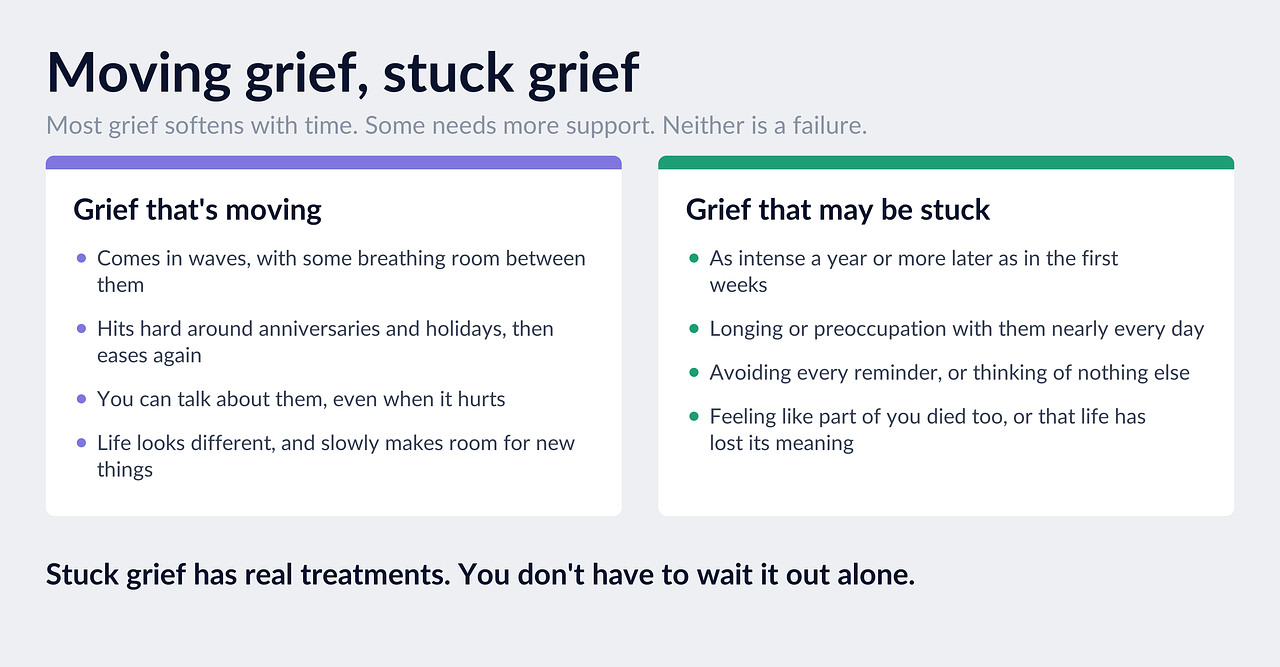
Grief doesn't move in a straight line or wrap up on a deadline. For most people, the sharpest edges soften with time, though it often comes back in waves, sometimes years later, set off by a song, a smell, or nothing you can name. Still missing someone years later is common, and it usually says more about how much they mattered than about how well you're grieving.
Anniversaries, birthdays, and the holidays
The calendar has a long memory. A birthday, the date of a diagnosis, the anniversary of the day you moved out, the first holiday with an empty chair. For some people the weeks leading up to a date are harder than the day itself, and it can knock you sideways if you didn't see it coming.
Holidays are their own category, because they come with built-in expectations about joy and togetherness and a script that assumes everyone's still here. A few things people find useful: deciding ahead of time what you will and won't do this year. Giving yourself permission to change a tradition, or to keep one exactly as it was. Making room for the person you're missing, whether that's their recipe on the table or saying their name out loud. Having an exit plan for the party. None of these are rules. Grief is allowed to change your plans.
When grief gets stuck
For most people, grief changes shape over time, even if it never fully leaves. For some, it doesn't. The loss stays as sharp at a year or two as it was in the first weeks, and life stays on hold around it. When this follows a death, clinicians now have a name for it, prolonged grief disorder, added to the diagnostic manual in 2022. An estimated 4 to 15 out of every 100 bereaved adults go through it.
Some signs it might be more than grief working its way through: longing for the person, or being preoccupied with them, nearly every day well past the first year. Feeling like part of you died too. Struggling to believe it really happened. Steering around every reminder, or being unable to think about anything else. A sense that life has lost its meaning, or that you don't fit anywhere without them. Being stuck isn't a character flaw, and it isn't a failure to love someone the right way. It's a reason to get support that's built for it.
The formal label only covers a death, but other losses can get stuck too, and you don't need a diagnosis for it to be worth talking about. Grief and depression also overlap, and sometimes both are happening at once. When a loss was sudden or frightening, grief can tangle with trauma as well.
Related: the depression page, the trauma page.
What grief therapy actually looks like (mostly: talking)
Grief is what attachment does when the person, or the life, isn't there anymore. A grief therapist's job is rarely to get you to let go or find closure on a schedule. Many work from the idea that you can keep a bond with who or what you lost while you build a life with room for it.
For grief that's stuck, structured approaches work on two tracks at once: coming to terms with the reality of the loss, and rebuilding a life with goals and some satisfaction in it, even without them. Prolonged grief therapy is one built specifically for this. In practice, that can mean telling the story of the loss at your own pace, slowly returning to places or routines you've been avoiding, or writing to the person you lost.
Cognitive behavioral therapy helps with the thoughts that keep grief stuck. “If I'd pushed him to see a doctor sooner, he'd still be here” is a common one, and you'd look at it together against what you actually knew at the time, which is usually a lot less than hindsight claims. CBT can also help with the sleep problems that so often come with grief.
There's no medication that treats grief itself, though if depression has moved in alongside it, a psychiatrist can talk through options. What helps depends on you, which is the real reason matching matters.
The first sessions are mostly about the person, or the thing, you lost. You get to talk about them, which a lot of grieving people quietly stop getting to do once everyone else has moved on. Therapists on our platform will tell you people often open with “I know I should be past this by now.” Nobody in that room is keeping a clock.
Grief is one place support groups make a lot of sense
There's a specific relief in a room, or on a video call, full of people who don't flinch when you say the word died. Support groups help many people feel less alone with a loss, and isolation is one of the things that tends to keep grief stuck. Some of the therapists on saymore also run support groups, virtual or in person: professional support alongside other people who get it, without the weekly one-on-one.
The saymore community is open any time, too, with anonymous posting and commenting for the 3 a.m. version of grief that doesn't fit a group's schedule. Some people do a group and individual therapy at once. Some start in one and drift to the other. Some stay in the community for good. All of it counts.
The search is the worst part
Loss comes with its own paperwork. Calls to make, accounts to close, forms with a box for the date. The last thing you need is a second project: comparing therapist bios at midnight, sending cold emails, explaining your loss to a stranger on an intro call before they've even said whether they have openings.
The Match skips it. One intake about what you're looking for. We match you with California therapists who fit, including therapists who work with grief and loss, and you see why you were matched. Then nothing happens until you decide it does. Nobody contacts you first. No therapist even sees your name unless you reach out.
Related: how The Match works.
From the saymore blog
Our founder writes from the inside, not the podium. Start with Friendship Breakups: What I Learned in the After, then Dedicated to Andrea Gibson.
Related: Friendship Breakups: What I Learned in the After, Dedicated to Andrea Gibson.
A note on this page